Italiano
 Polski

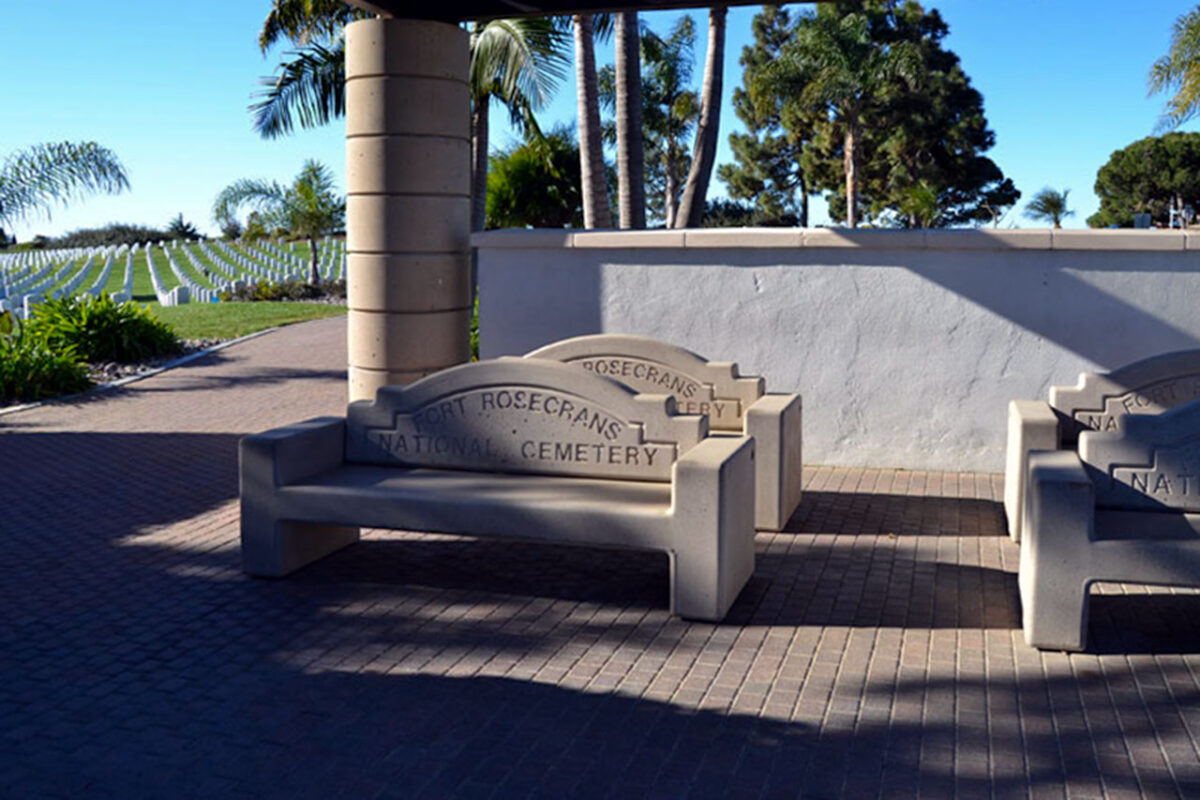
If someone asked me where I would like to rest after death, I would probably say: Green-Wood Cemetery in Brooklyn – because the view of Manhattan from there is the best. But when I came across Fort Rosecrans National Cemetery, I thought that San Diego also has its cemetery with views that are hard to beat. The rows of white headstones stretch across the hills of Point Loma, and the bay and ocean panorama is so impressive that for a moment you forget where you are standing.
The first time I came here was on the way back from Cabrillo National Monument. It was the end of December, but the sun was shining as if it were mid-July. There was no trace of fog, and the views… well, they were simply marvelous. On one side, the bay of San Diego, on the other, the open Pacific – and only those neat rows of white headstones reminded that this place is primarily a cemetery, not a viewpoint. If you want to learn its history and see why it’s worth visiting, read on.
Fort Rosecrans National Cemetery in brief
History of the Point Loma hillside cemetery dating back to the 19th century
Fort Rosecrans National Cemetery did not appear on the map overnight. Its origins date back to 1852 when President Millard Fillmore designated the southern part of Point Loma — then about 567 acres — for military use. The place is named after General William Starke Rosecrans, a Civil War hero, congressman from California, and interestingly, also an inventor.
One of the events that became part of the history of this place was the December Battle of San Pasqual in 1846, during the Mexican-American War. Nineteen soldiers commanded by General Stephen Watts Kearny died then. Initially, they were buried where they fell, later — in 1874 — they were moved to the San Diego Military Reservation, and in 1882 their remains were transferred to what is now Fort Rosecrans.
In 1922, the residents of San Diego funded a commemorative boulder from the battlefield with a plaque memorializing the fallen — and it is one of the oldest monuments that can be seen at the cemetery today.
Tragedy of USS Bennington in the port of San Diego
July 21, 1905, San Diego woke up to news of a disaster that shook the entire city. On board the USS Bennington, anchored in the port, a steam boiler exploded. 62 sailors were killed, and most of the crew were injured. At that time, it was the greatest tragedy that had ever affected the city.
Two days later, the victims were laid to rest in a specially designated section of the cemetery, called Bennington Plot. For some time, it was even referred to as the ‘Bennington National Cemetery’. To this day, one of the most distinctive places in Fort Rosecrans is the granite obelisk commemorating this disaster – it’s impossible to miss while walking down the main avenue.

How Fort Rosecrans became a national cemetery
October 5, 1934, Fort Rosecrans officially became part of the national cemetery system. One of the reasons for this decision was the overcrowding of the then-existing national cemetery in San Francisco, which served veterans from all over northern and central California. Combined with changes in law – expanding the list of people eligible for burial – and the rapid increase in the population of southern California, choosing Point Loma for the next necropolis was a natural step.
In the following years, the place began to take its current shape. By 1938, thanks to funding from the Works Progress Administration (WPA) program, Spanish-style administrative buildings and walls marking the boundaries of the area were built here.
The location of Fort Rosecrans National Cemetery and views that are memorable
Fort Rosecrans National Cemetery covers 31.4 hectares on the hills of Point Loma, about 16 kilometers west of downtown San Diego. The necropolis lies on both sides of Point Loma Boulevard, and its location provides views of both the bay and the open ocean.
Looking eastward, there is a panorama of San Diego Bay with the downtown skyscraper silhouette, the Coronado Bridge, and Coronado Island itself. Also visible is the port with moored US Navy ships and the movement of yachts and ships.
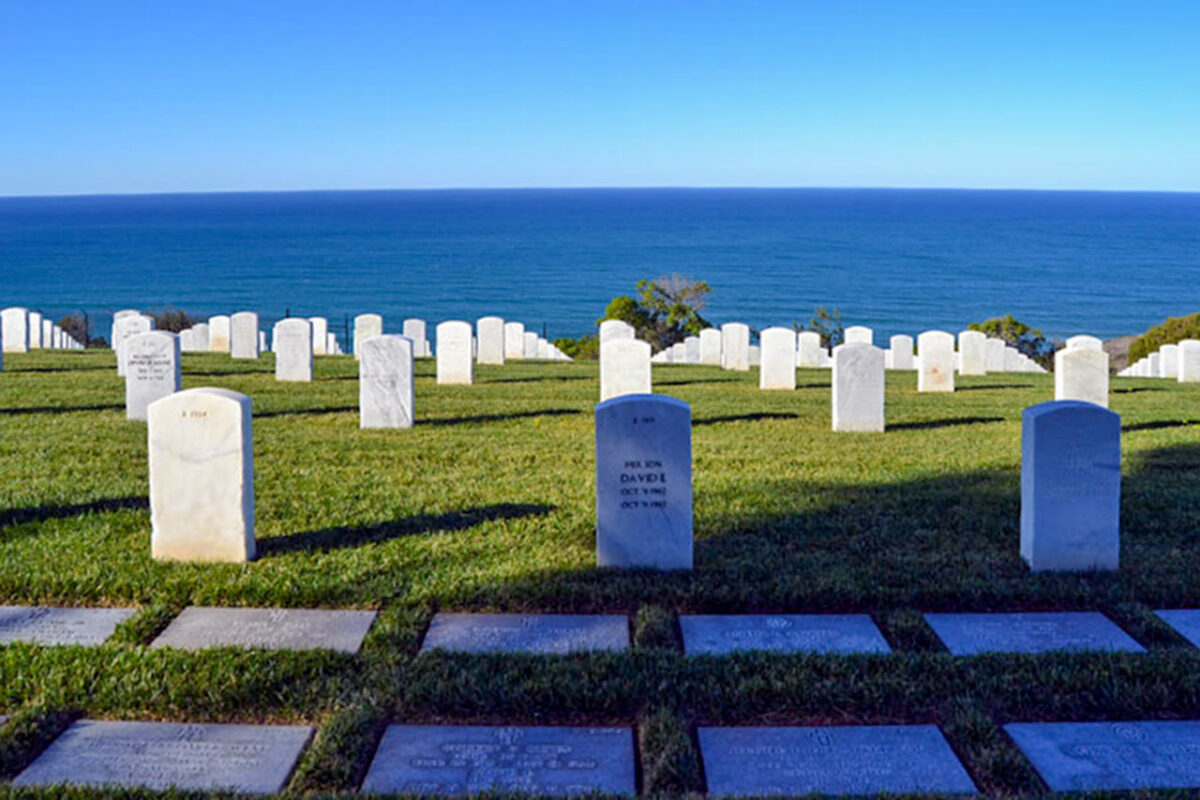
To the west, the horizon is filled by the vastness of the Pacific Ocean. On clear days, the Islas Coronado located in Mexico can be seen, and at sunset, the water glistens with gold and red.
This is one of the few places in San Diego where just crossing the road takes you from views of the urban skyline to open ocean vistas.
What you will see while walking through the cemetery
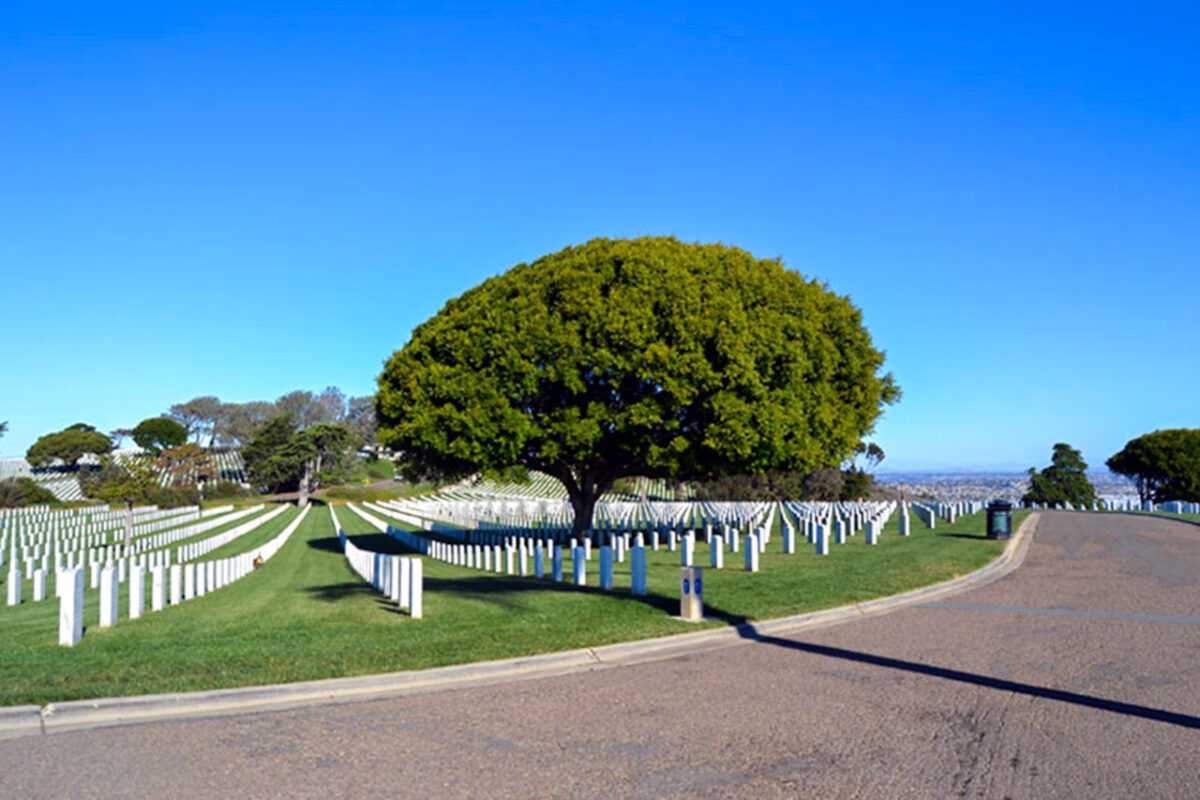
Fort Rosecrans is not just rows of white headstones stretching to the horizon. Every few steps, you come across places that stop you for longer. For example, the granite-brown monument of USS Wasp, commemorating sailors who died during the Battle of Guadalcanal in 1942. Or the monument of the Battle of San Pasqual – a simple boulder from the battlefield, but with a plaque bearing the names of the fallen, reminding us of the Mexican-American War.
It’s impossible to overlook the previously mentioned obelisk dedicated to the victims of the explosion on the USS Bennington from 1905. In the newer parts of the cemetery, you’ll find columbariums, modern structures for urns after cremation, added only in the 21st century.
There are also places of exceptional significance. In section G rests Herbert Charpoit Jones – a Pearl Harbor hero.
Among the more than one hundred thousand graves, there are at least 23 Medal of Honor recipients – the highest military decoration in the USA. Their names appear in war history from the end of the 19th century to the times of the Vietnam War.
Practical Information
Opening Hours
Visiting Rules
This is a memorial place, so simple rules apply: no weapons, no walking dogs (unless it’s a guide dog), no picnics, no running, and no cycling allowed. And absolutely – no parking on the grass.
How to get there?
From downtown San Diego, you can get here via Catalina Boulevard, turning earlier from Rosecrans Street. If you are coming from I-5 or I-8, follow the signs to Point Loma – the route is well marked.
Parking
Free, but it can be crowded on weekends and during ceremonies. After entering Cabrillo Memorial Drive, the administrative building will pass on your right.
Public Transportation
If you really want to take the bus, the closest option is line 28 San Diego Transit, but it’s still for the very determined – in practice, a car will be more convenient.
Best time to visit
Fort Rosecrans looks great at any time of the year – after all, it’s San Diego, where the average temperature hovers around 21°C. But if you want to catch the best conditions, it’s worth considering a few things.
Season
Time of day
How much time to plan for a visit
If you just want to stop for a moment, take in the panorama, and snap a few photos, half an hour is enough. But if you want to walk through both parts of the cemetery, the one with a view of the bay and the one with a view of the ocean, and check the most important monuments and read the plaques, reserve at least an hour. It’s a peaceful place with its own atmosphere, so it’s better not to rush through it.
What to bring with you

Combine a visit to the cemetery with other attractions
Fort Rosecrans is just a few minutes away from places that can easily be included in a single Point Loma sightseeing plan. Right after the entrance gate begins the road to Cabrillo National Monument and Old Point Loma Lighthouse, where you will see both historical places and impressive ocean views. A few minutes’ drive in the opposite direction will lead you to Sunset Cliffs, where you can admire one of the most beautiful sunsets in San Diego. And if you’re in the mood for a more relaxed atmosphere, bars, and vintage shops, visit the nearby Ocean Beach.
FAQ – frequently asked questions
No. Admission and entry are free of charge.
Yes, but remember that this is a memorial site – it is worth explaining its significance to your children beforehand.
Yes, as long as you are respectful and do not disturb other visitors.
Only in a vehicle or with an assistance dog (e.g., a guide dog for the blind).
No. Picnics, running, and cycling are prohibited.
Yes. On one side, there is a panoramic view of San Diego Bay and Coronado, and on the other, the endless Pacific Ocean.
Approximately 30-45 minutes, unless you want to explore the area more thoroughly and see all the monuments.
Useful links:
Summary
Fort Rosecrans is one of those places that stays in your mind not because of what you read about it in a guidebook, but because of what you see on the spot. The eye immediately runs along the even rows of white gravestones and then escapes further – to the bay on one side and the open ocean on the other. The view is so wide and clear that it’s hard to break away. Add to that the breeze from the ocean and the silence…
This is not a place for a quick walk and a photo with a view. It’s better to give yourself a moment to look around in silence and feel the atmosphere of this hill. If you happen to be here on a clear day, especially in the morning or just before sunset, you will see San Diego in the best light. And when you leave, you will be left not only with the image of beautiful views, but also with thoughts of the people who rest here.
If you visit Fort Rosecrans, do it slowly. Stop. Look. Think.