Italiano
 Polski

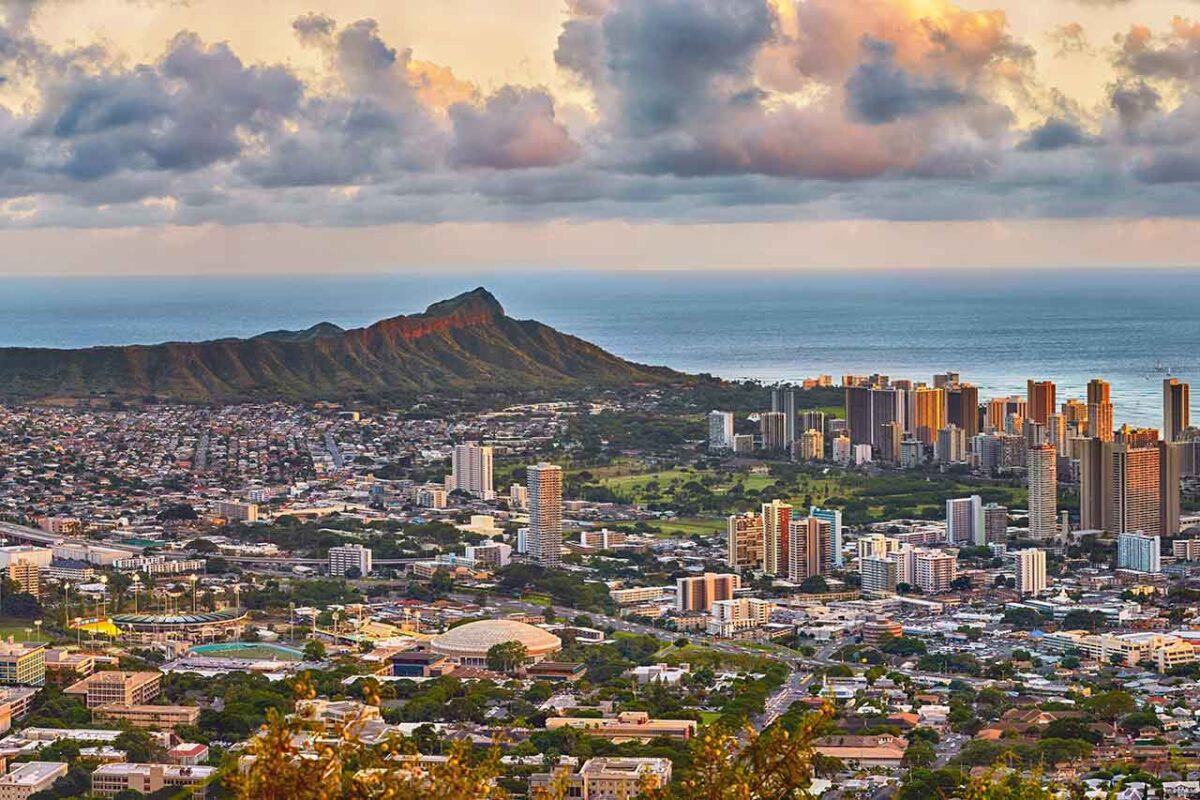
The area around Diamond Head is full of ‘volcanic history,’ including the Ko’olau mountain range and Koko Head. The Ko’olau Range has its highest point, Mount Ka’ala, at 1227 meters, while Koko Head rises to 368 meters. The geology of Hawaii is shaped by tectonic plate movements and volcanic activity on the Big Island, revealing the processes occurring within the Earth’s interior.
The areas surrounding Diamond Head also have coral reefs and marine terraces, showcasing past sea levels and the area’s history. This natural wonder Oahu is not only about beauty but also a lesson about the forces that have shaped the Hawaiian Islands for millions of years.
Exploring the Legends of Leahi
Diamond Head, known to Hawaiians as Lē’ahi, is not only a geological wonder but also a place of great cultural and spiritual significance. For centuries, different Hawaiian communities have inhabited the surrounding areas, and the mountain has played an essential role in their history, mythology, and beliefs.
The Legend of Pele and Hiiaka
One of the most famous legends associated with Lē’ahi tells of the volcano goddess Pele and her younger sister Hiʻiaka. According to this tale, the sisters stopped at the crater during their journey in search of a new home. It was Hiʻiaka who gave the mountain its name Lē’ahi, because she thought the summit resembled the shape of a tuna fish’s forehead, ahi.
Another meaning of the name “Leahi”
Another version of the legend says that the name Lē’ahi comes from the phrase ‘lei ahi‘, which means ‘wreath of fire‘. This refers to the fires lit at the top of the crater, which served as beacons for boats and canoes passing nearby.
Cultural Heritage of Diamond Head
Regardless of its origin, the name Lē’ahi has great significance in Hawaiian culture. The shape and location of the mountain are inextricably linked to numerous stories and beliefs of the native people. The crater itself is located in the traditional district of Kona, extending from Kuli’ou’ou to Moanalua on the eastern shore of Oʻahu, and represents a key element of its heritage.
Tales related to Lē’ahi have stood the test of time and continue to fascinate both island residents and visiting tourists. They are a testament to the richness of Hawaiian mythology and the enduring influence that this extraordinary natural monument has had on Hawaiian culture and imagination.
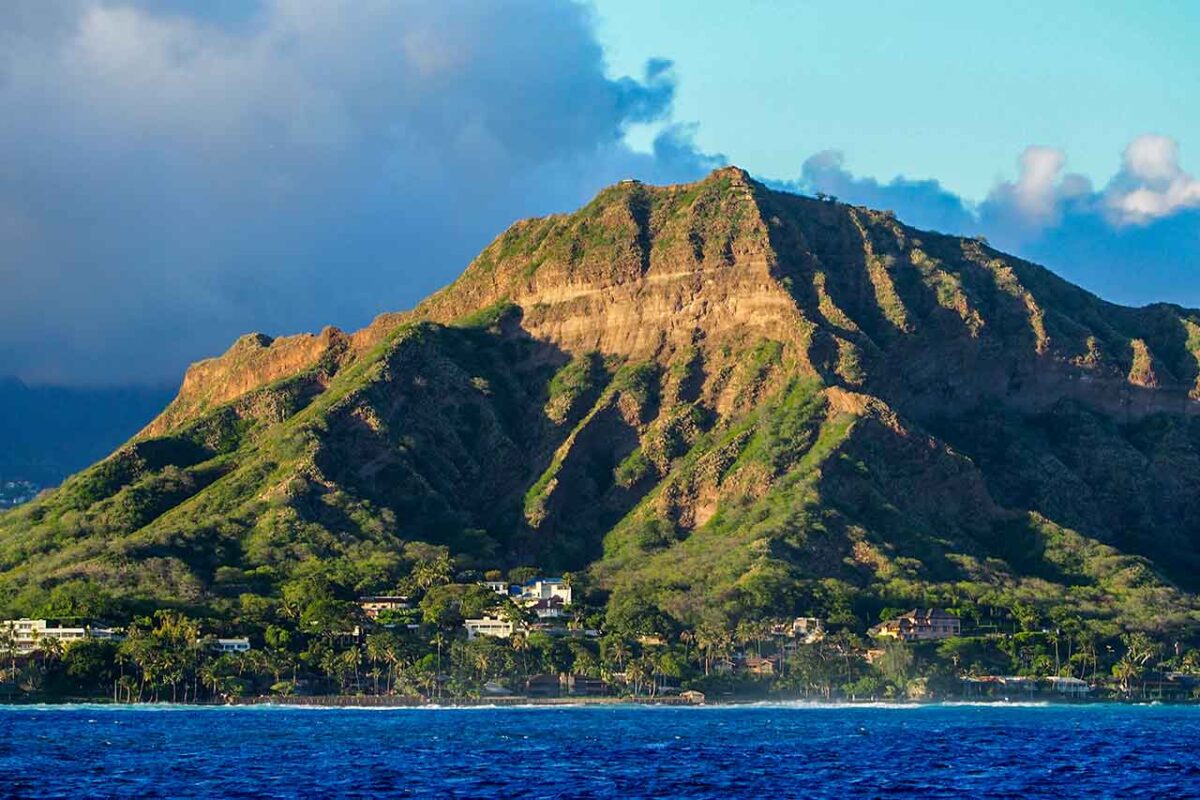
It is worth remembering that there are many different versions of the legends associated with Diamond Head, often differing in details. Some of them may be less known or have a local character. Nevertheless, they all emphasize the unique place of this volcanic crater in the spiritual and cultural landscape of Hawaii.
Climbing Diamond Head – A Challenge for the Average Tourist
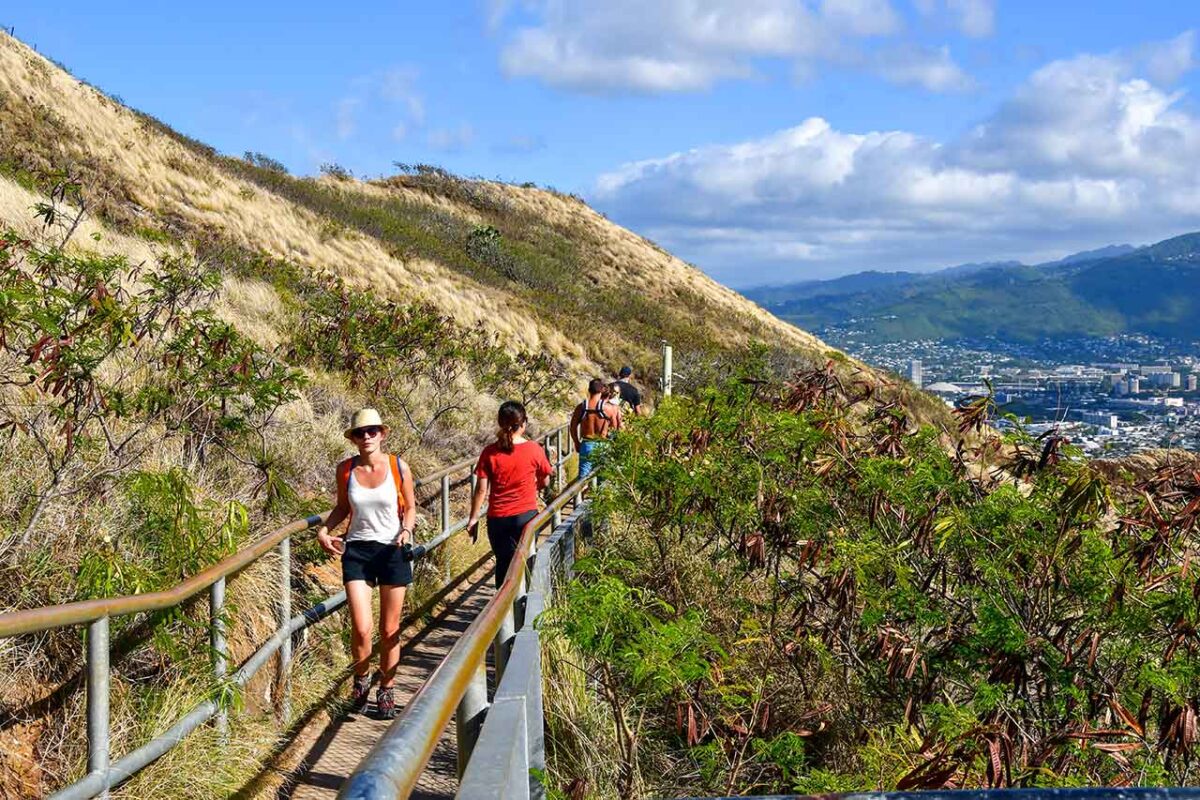
Although the climb to Diamond Head in Hawaii is not considered very difficult, it requires some effort and proper preparation. The trail to the crater’s peak has a length of 2.5 km round trip and 171 meters of elevation gain. Completing the entire route takes on average 1.5 to 2 hours.
Moderate Difficulty Level
The trail itself, although technically easy, can be moderately demanding in terms of fitness. The route passes through varied terrain – from concrete and gravel paths, through numerous stairs and steps (including long staircases), to two dark tunnels. People with lower fitness levels may have difficulty overcoming the steep ascents and hot conditions present on the trail.
Challenges on the Trail
Besides the trail itself, the conditions on the trail can also present challenges for hikers. Intense sunlight, high temperature, high humidity, and crowds of other tourists (Diamond Head is visited by about 3000 people daily) can make the hike more difficult.
To prepare properly for entering Diamond Head, it is recommended to bring plenty of water, a hat, sunglasses, and comfortable hiking shoes. During the hike, it’s important to maintain a slow and steady pace, stay hydrated frequently, and take breaks in shaded areas.
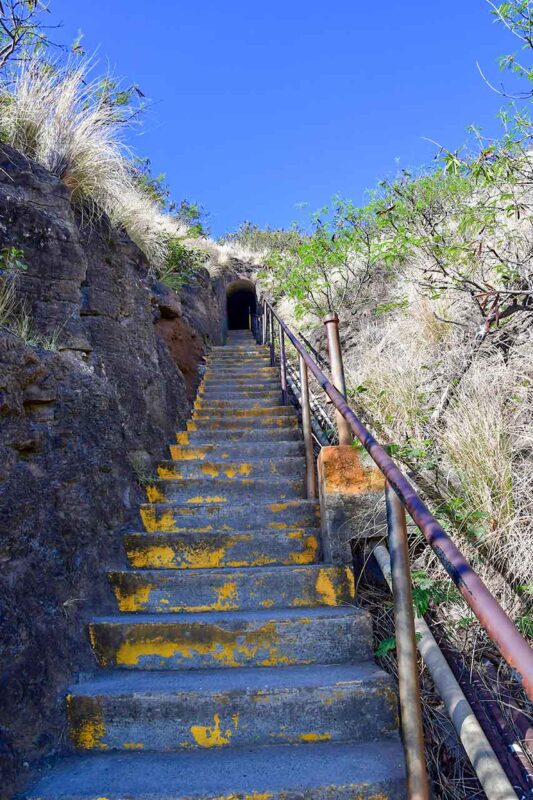
Panoramic views of Oahu and the Pacific
At the summit of Diamond Head, breathtaking 360-degree views of the island of Oahu and the vast Pacific Ocean unfold. From the viewing platform of the Fire Control Station, once used by the military to direct artillery fire, there is an unparalleled panorama of the island’s southern coast.
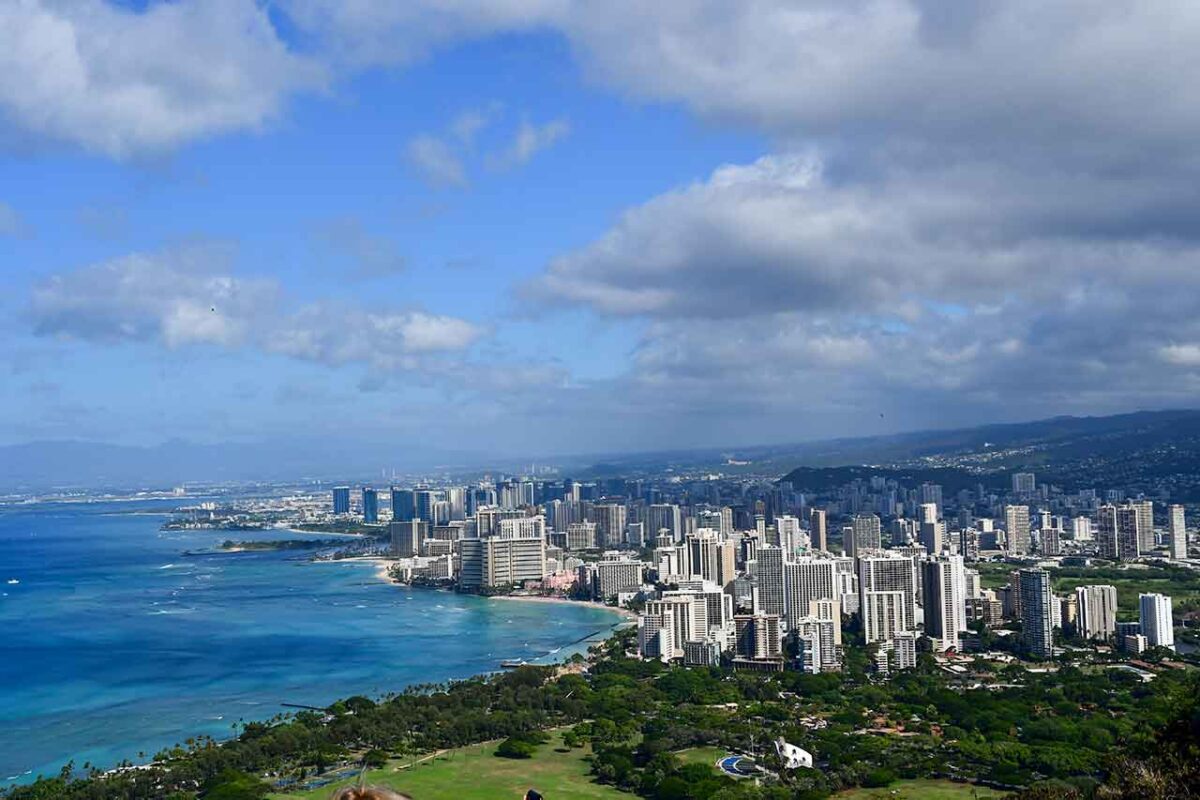
In the foreground, the famous Waikiki Beach – a crescent of golden sand caressed by the azure waters of the Pacific – captures attention. This iconic view, made famous on countless postcards and photographs, takes on a whole new dimension when seen from a bird’s-eye view. Along the beach stretches the Waikiki Beach Walk and Kalakaua Avenue with luxurious hotels, shops, and restaurants. The skyscrapers of Honolulu, though surprisingly low from this perspective, create a picturesque backdrop for the sandy arc of the beach.
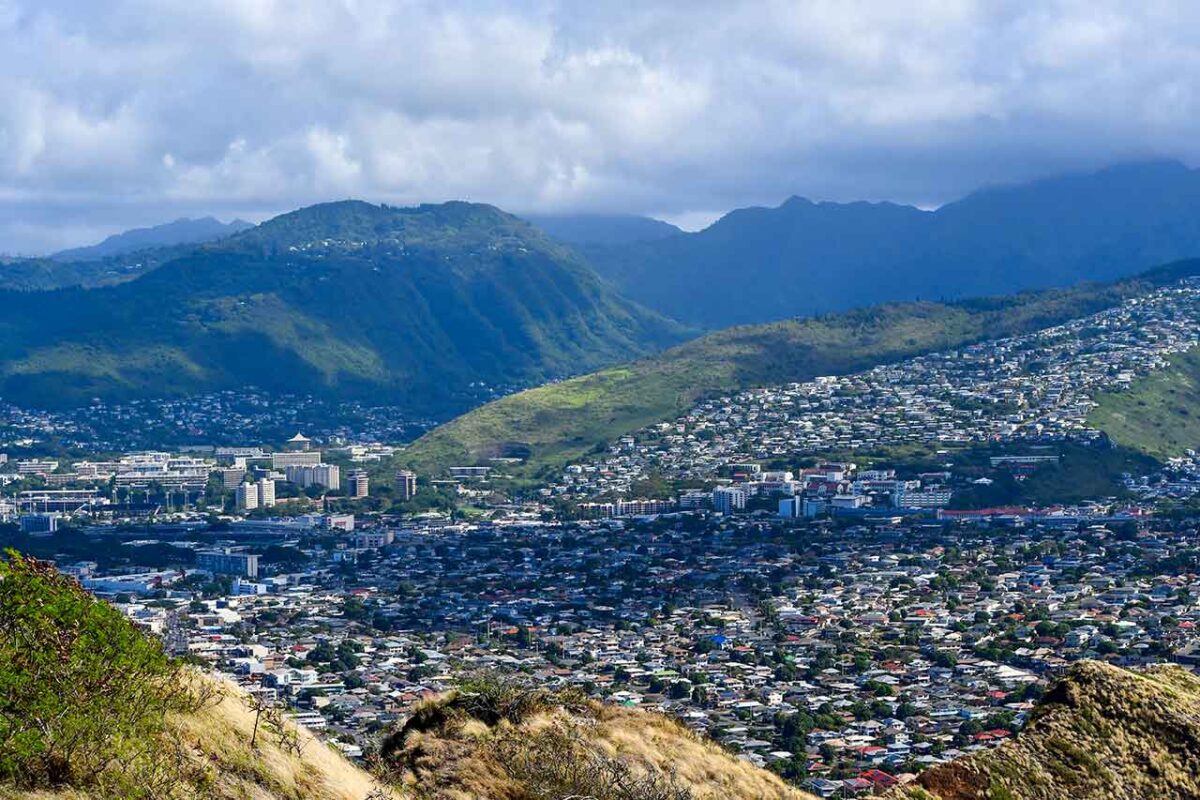
Further east, beyond Waikiki, the coastline becomes more rugged and wild. Steep cliffs plunge into the sea, and waves crash against volcanic rocks. Other volcanic craters can also be seen from here – Koko Head, Hanauma Bay, and Koko Crater. The emerald island of Molokai is also visible in the distance.
To the west of Diamond Head lies the neighborhood of Kapahulu with hidden beaches and secluded coves. On a clear day, you can see the distant Barbers Point and traces of former fields on the slopes of the Waianae Mountains.
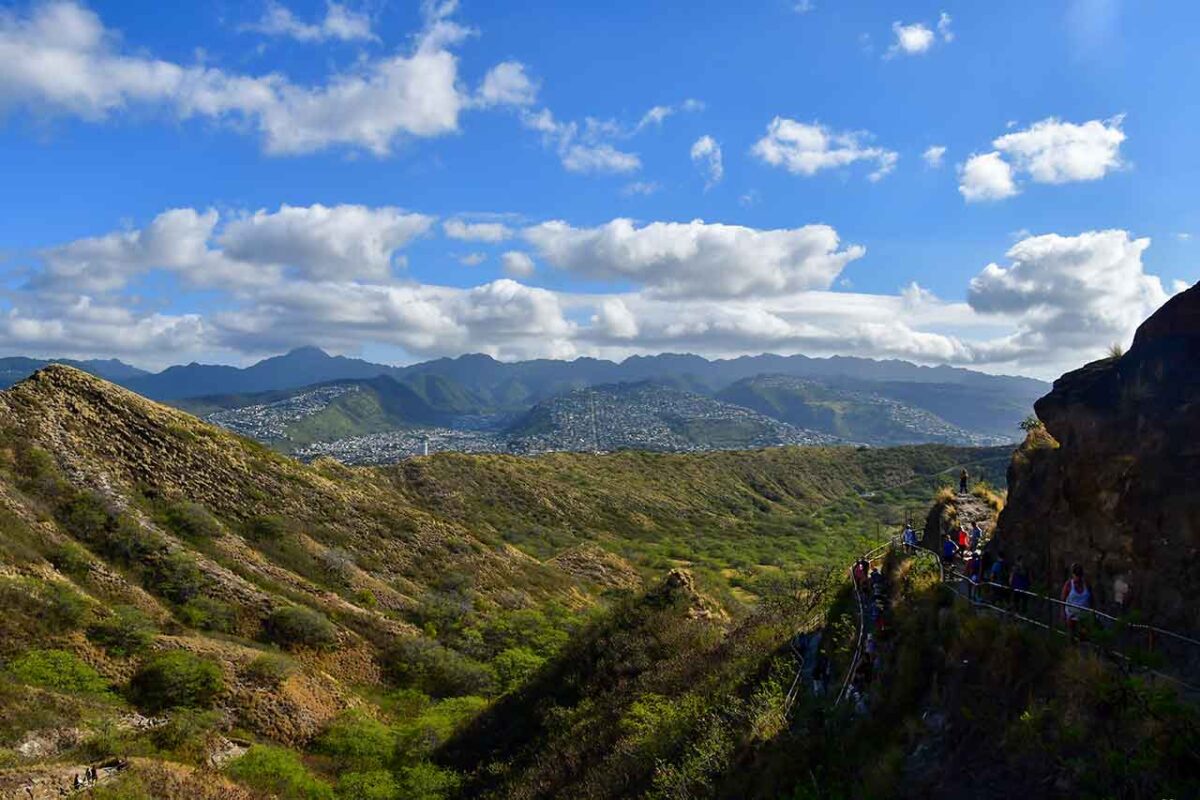
At the foot of the crater, you can see the lush vegetation covering its inner slopes and the winding path by which we reached the summit. From this perspective, the distinctive shape of Diamond Head is clearly visible, with its steep walls and flat crown.
The view from the top of Diamond Head is undoubtedly one of the most spectacular views on Oahu, and perhaps all of Hawaii.
Diamond Head: a witness to military history
Diamond Head is not just a climbing destination; it is also an important element of the military history of Oahu. In 1904, the United States government purchased the area of Diamond Head and established Fort Ruger there. It was the first military reservation in Hawaii, and its main purpose was to defend the port of Honolulu.
Fort Ruger and coastal defense systems
Fort Ruger, thanks to its strategic location on Diamond Head, played a key role in Oahu’s coastal defense system. Its location provided an excellent view of the surrounding waters, allowing for early detection of potential threats. Although the fort’s guns were never used in a real battle, its presence was a significant deterrent to potential invaders.
In the years 1909-1921, Fort Ruger served as the main coastal artillery headquarters on Oahu. It was the best-preserved among all forts in the Honolulu Artillery District. Besides defending against sea attacks, the fort was also tasked with protecting Honolulu from potential land force landings from the eastern part of the island.
Remains of bunkers and artillery installations
Today, on the grounds of Diamond Head, you can find remnants of former military installations, such as concrete bunkers, combat shelters, and artillery positions. Many of them are accessible to visitors. These objects are silent witnesses to the role Diamond Head played in Oahu’s defense system.
A particularly interesting object is the Battery Harlow – a massive concrete structure originally equipped with eight 12-inch mortars. Other noteworthy fortifications include Battery Birkhimer, Dodge, and Hulings as well as one of the newest – Battery 407 from World War II.
Though today most of these objects no longer serve their original function, some are still used by the Hawaiian National Guard for training and storage purposes. They stand as living testimony to the military history of this place.
Visitor amenities and educational opportunities
Diamond Head State Monument offers a variety of amenities and educational programs for tourists. The Diamond Head Information Center, built in 2000, is the main facility providing visitor services. It features exhibits on the history, culture, geography, and natural beauty of the crater. In 2014, the center was upgraded and now also offers Diamond Head-related souvenirs.
Diamond Head – Visitor Information
When planning a trip to Diamond Head on Oahu, it’s important to prepare properly to ensure a safe and enjoyable visit. From May 12, 2022, non-Hawaii residents must make an online reservation before visiting Diamond Head State Monument. Reservations can be made up to 14 days in advance (with plans to extend this period to 30 days). This applies to both entry and parking reservations.
Reservations can be made through the Diamond Head State Monument online reservation system
Parking Fees
Hawaii residents may enter and park for free by presenting valid identification. However, out-of-state tourists must pay a fee of $10 per vehicle and an additional $5 per person. Payment can only be made by credit card during online booking.
Parking Location at Diamond Head
The main parking lot is located inside the Diamond Head crater. After going through the Kahala tunnel, there is a large parking area on the right near the information center and public restrooms. Due to the reservation system, you should always be able to find a spot, even when arriving later.
Alternative parking options
If the main parking is full, additional spaces are available outside the crater along Diamond Head Road. However, prepare for a longer walk to the trailhead. There are also private parking facilities in the area, such as at Kapiolani Community College, but they are usually paid.
Public transportation access
If you want to avoid parking issues, consider taking the city bus. Lines 23, 24, and 98 stop near the park entrance. This is a convenient option especially for those traveling from Waikiki.