Italiano
 Polski

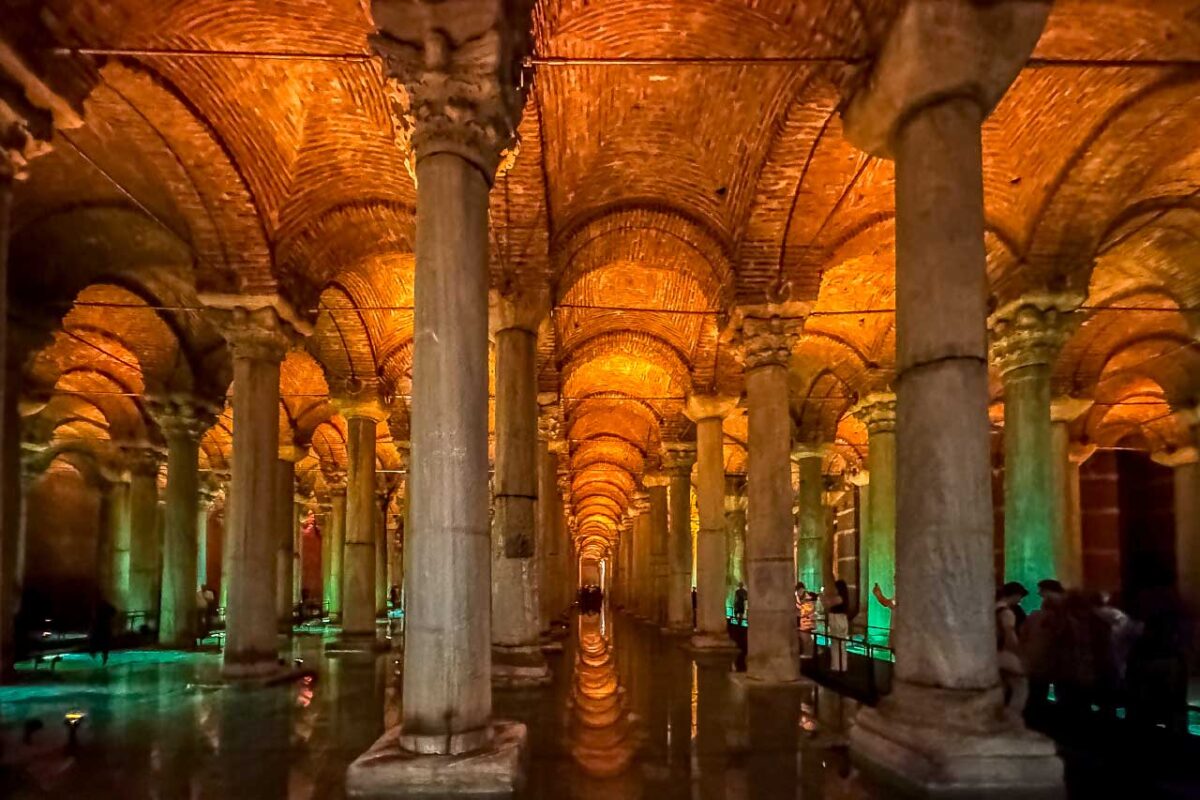
Every year over 2.2 million tourists descend 52 stone steps into the underground of Istanbul to admire one of the most important monuments of Byzantine architecture. The Basilica Cistern, also known as the Sunken Cistern (Turkish: Yerebatan Sarnıcı), is the largest surviving underground water reservoir from the medieval period.
It’s not surprising that this underground palace attracts hordes of visitors. Beneath the streets of modern Istanbul lies a true architectural gem – a hall of almost 10,000 square meters, supported by hundreds of marble columns, where each step echoes through the vaulted ceiling.
History of the Sunken Basilica Cistern in Istanbul
Origin of the construction of the underground water reservoir in the 6th century
The Basilica Cistern was built in 532 AD under the order of Emperor Justinian I the Great – the same ruler who commissioned the construction of the famous Hagia Sophia. The decision to erect it was not random. After the bloody Nika revolt in the same year, which almost destroyed the city with flames, the emperor decided not only to rebuild the destroyed buildings but also to protect Constantinople from future sieges.
The place where the cistern is today was not chosen by chance. Previously, this was the basilica of Saint Elias (lat. basilica Sancti Eliae), one of the most important churches of ancient Constantinople. After its destruction in 532 during the Nika revolt, Justinian decided to use these underground spaces to create a gigantic water reservoir.
Water supply system of Constantinople
During Byzantine times, Constantinople had about half a million inhabitants, making it one of the largest cities in the world at the time. The problem was that the peninsula on which Istanbul is located practically has no natural sources of drinking water.
The solution was aqueducts: impressive engineering structures that transported water from distant sources. The Basilica Cistern was mainly supplied by the Valens Aqueduct (Bozdoğan Kemeri), which can still be admired in Istanbul today, and by the Malovaz Aqueduct system. The water flowed from the Belgrade Forest, located 19 kilometers north of the city.
The cistern was intended to provide water to the imperial palace in case of war or poisoning of the water from the aqueducts. This gigantic underground reservoir could hold 80-100,000 cubic meters of water, ensuring water security for the city even during the longest sieges.
After the conquest of Constantinople by the Turks in 1453, the cistern gradually fell into oblivion. The new rulers preferred fresh water directly from the aqueducts and did not fear the siege of the city. Due to these preferences the cistern was abandoned and forgotten until the mid-16th century, when the Dutch traveler Gyllius rediscovered it, noticing that the locals extracted water from small holes in their basements and even fished there.
Construction of a monumental work
According to historical sources, about 7000 workers were involved in the construction. It is said that many of them died during the completion of this ambitious project. Construction began in 532 during the reign of Emperor Justinian I and lasted until 542.
The finished cistern was an impressive engineering work – it was 140 meters long and 70 meters wide, covering an area of about 10,000 square meters. Its interior is supported by 336 marble columns, each 9 meters high, arranged in rows of 28 columns each. The cistern could hold up to 80,000 tons of water, supplying the Great Imperial Palace and the surrounding buildings.
After the conquest of Constantinople by the Ottomans in 1453, the cistern still served for a while as a water source for the gardens of the Topkapı Palace. When the Turks created their own water systems, the cistern was abandoned and forgotten until its rediscovery by the Dutch traveler Petrus Gyllius between 1544 and 1550.
Ottoman times and oblivion
After the conquest of Constantinople by the Turks in 1453, the Basilica Cistern initially continued to serve as a water distribution center for the Sarayburnu and Bahçe Kapısı areas. It was also used to meet the needs of the Topkapı Palace. However, when the Ottomans created their own water systems and repaired ancient Byzantine aqueducts, the function of the cistern as a water distribution center was partially limited.
Rediscovery
In the mid-16th century, this structure was ‘rediscovered‘ for the Western world by the French naturalist and topographer Petrus Gyllius, who lived in Istanbul from 1544 to 1555. He was the first to conduct systematic measurements of the cistern, determining that it was 336 feet long, 182 feet wide, and its perimeter measured 224 Roman steps.
Gyllius carefully counted all the columns – he recorded exactly 336 of them – and in his studies, he noted the existence of numerous wells on top of the cistern. In his notes, he mentioned that the residents of the neighborhood were well aware of the cistern’s existence and actively used it, writing that ‘they draw water with buckets and even navigate with boats inside, illuminating the space with lamps and fishing. Through the wells, air and light enter the cistern, and the fish swim in these beams‘.
Modern history of the cistern
Between 2016 and 2022, the cistern underwent the most extensive restoration in its history. 1,440 m³ of cement mortars damaged by later periods were removed along with significant amounts of concrete from the sidewalk structure.
These were replaced with lightweight and modern modular steel platforms. The structure was reinforced against earthquakes, replacing old steel elements with a modern stainless steel tension system. For the first time in 1500 years, the original brick floor was exposed.
Architecture of the cistern
Dimensions and structure
Basilica Cistern is particularly enchanting due to its size. Descending, one sees a rectangular chamber of 143 meters in length and 65 meters in width, providing an area of 9800 square meters. The interior height is 9 meters, and the entire space can hold up to 100,000 cubic meters of water (about 80,000 tons).
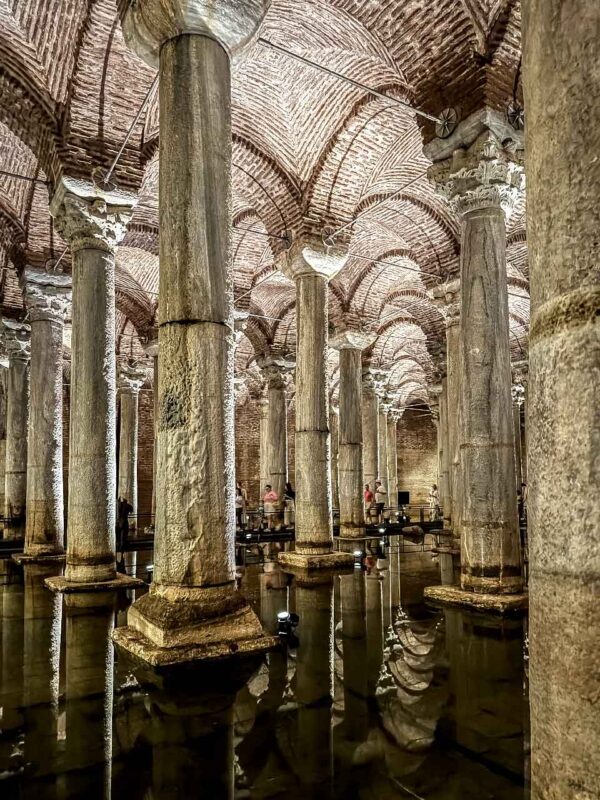
The structure is based on a system of 336 columns arranged in 12 rows of 28 columns each. The columns are spaced 4.8 meters (about 16 feet) apart, creating a regular pattern reminiscent of a forest of stone pillars.
Columns from different eras
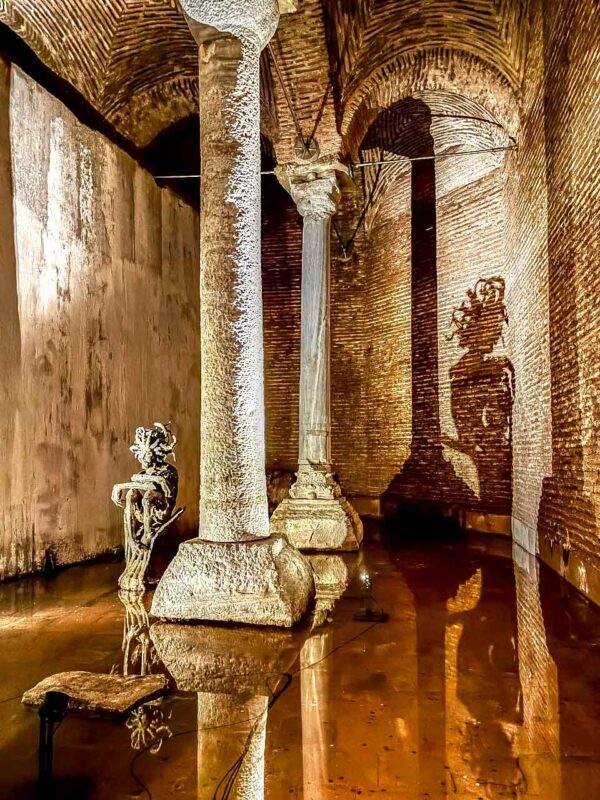
One of the most fascinating features of the Basilica Cistern is the variety of its columns. The Byzantine builders, wishing to speed up construction and reduce costs, used columns from previously demolished buildings – pagan temples, Roman baths, or destroyed palaces.
As a result, each column has its own history. Here you can find:
Even the materials vary, we find columns of white marble from the island of Proconnesus (now Marmara), as well as granite from Egypt or porphyry from Asia Minor.
Construction system
The vaulted ceiling of the cistern was created with bricks arranged in concentric squares. This construction, called a groin vault, ideally distributes the weight and is extremely resistant to earthquakes, which is why the Basilica Cistern has withstood over 20 strong shocks throughout its history.
The cistern walls have a thickness of 4.8 meters and were coated with a special hydraulic mortar, ensuring waterproofness and protection against groundwater infiltration.
Floor and drainage system
The original 6th-century floor was made of Byzantine bricks. In the 1980s, during restoration works, about 1440 cubic meters of concrete and 1600 cubic meters of sediment were removed to reveal the original flooring.
Byzantine engineers also took care of the drainage system – there are special openings and channels in the floor that allowed the complete emptying of the reservoir when maintenance was needed.
Most interesting elements of the Basilica Cistern
Construction system
The vaulted ceiling of the cistern was made of bricks, and its structure perfectly distributes the weight, ensuring exceptional durability – thanks to this, the Basilica Cistern has survived for over fifteen hundred years, including numerous earthquakes.
The cistern walls have a thickness of 4-4.8 meters and were coated with a special hydraulic mortar, ensuring stability and protecting against the penetration of underground water.
Flooring and Drainage System
The original floor from the 6th century was made with Byzantine bricks. In the 1980s, during major renovations, about 1440 cubic meters of concrete and 1600 cubic meters of sediment were removed to reveal the original floor.
Byzantine engineers were also concerned with the drainage system – there are special holes and channels in the floor that allowed the reservoir to be completely emptied if maintenance was needed.
Medusa Heads, Guardians of the Underground Palace
The most recognizable feature of the Basilica Cistern is the two Medusa heads that serve as column bases in the northwest corner of the reservoir. One is positioned upside down, the other sideways; I haven’t found any official explanation for this arrangement, but apparently, this strange positioning has its justification. According to Byzantine beliefs, inverting the Gorgon’s head was supposed to neutralize its power to turn everything it looked at into stone.
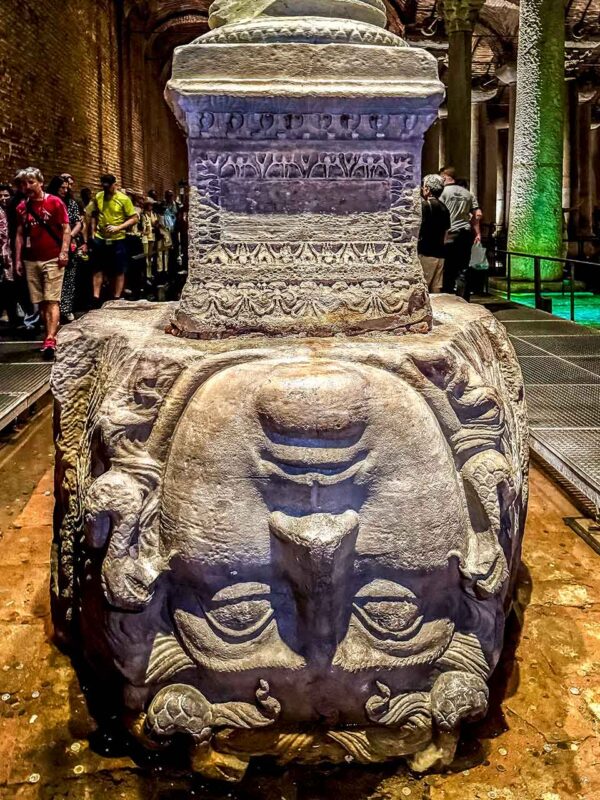
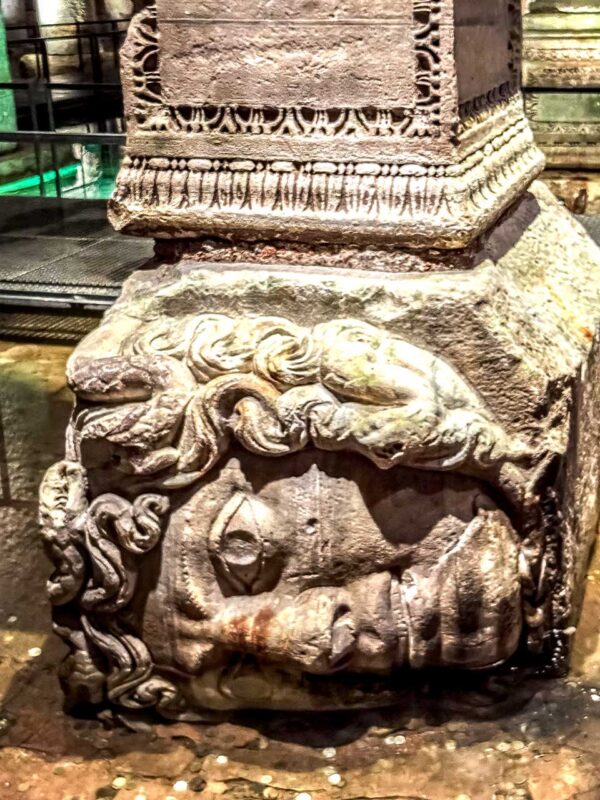
The origin of these sculptures also remains a mystery. Most archaeologists believe they originate from the Roman era and were transferred from a previous monument or temple. The quality of the work indicates that they were elements of a very important building – probably a forum or a triumphal arch.
In Greek mythology, Medusa was one of the three Gorgons – monstrous sisters with snake hair, whose gaze turned people to stone. Paradoxically, despite her monstrous nature, she was also considered a symbol of protection – her image was placed on shields, amulets, and important buildings.
Column of Tears
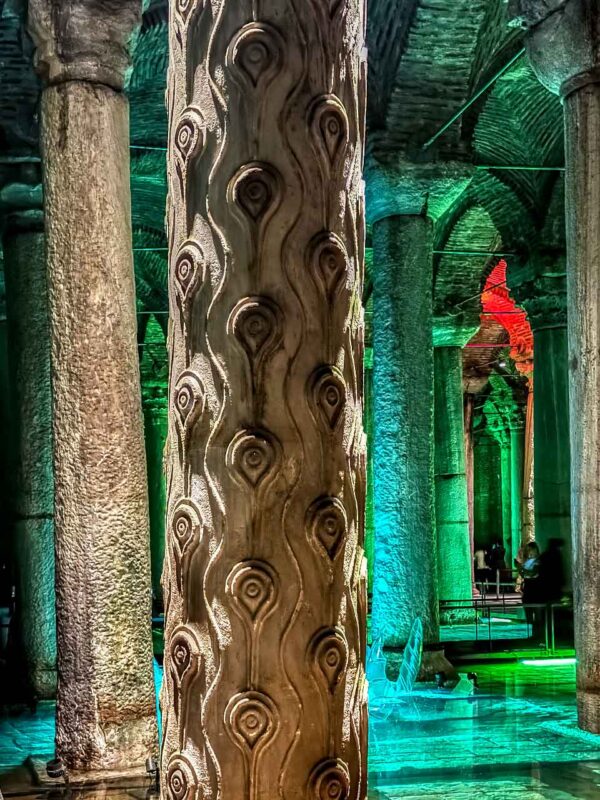
Among the hundreds of columns, ‘Column of Tears’ (Turkish Ağlayan Sütun) stands out, intriguing visitors for centuries. On its surface, distinctive motifs resembling an eye, surrounded by concentric circles, are visible, which indeed seem like traces of tears running down the stone.
According to a local legend, the column weeps for all the seven thousand slaves who died during the construction of the cistern. However, a more prosaic explanation points to the natural disintegration process of marble, which combined with humidity, creates these characteristic motifs.
Historical Inscriptions
On some columns, traces of Byzantine and Ottoman inscriptions can be seen. Some are marks of the stonecutters, others are memories of people who have visited this place over the centuries.
The cistern in culture – from Bond to Dan Brown
Hollywood Productions
The Basilica Cistern appeared on the big screen in 1963 in the film ‘From Russia with Love‘, the second episode of the James Bond series. In the scene with Sean Connery, agent 007 and Kerim Bey travel by boat among the columns, using the reservoir to observe a fictitious Soviet consulate. The dialogue in the film erroneously attributes the construction to Emperor Constantine and locates it beneath a Soviet building in Istanbul; in reality, the cistern was built, as I already mentioned, under Justinian I and is located in the Sultanahmet district, 150m southwest of Hagia Sophia, far from the former Russian embassy in Beyoğlu.
Contemporary Literature and Culture
In Dan Brown’s bestseller “Inferno” (2013), the dramatic finale takes place right in the Basilica Cistern, and in the 2016 film adaptation, shot mainly in a studio beneath Budapest, Tom Hanks appears in its faithful setting.
Basilica Cistern also appears in the Turkish Netflix series “The Protector”, where it constitutes one of the key locations for the action of the first season. It is also visible in numerous documentaries on the architecture and engineering of ancient Constantinople (including productions by the BBC and TRT).
Visiting the Basilica Cistern in practice
Opening hours and prices
Basilica Cistern (Yerebatan Sarnıcı) is open every day:
Ticket price for the Basilica Cistern
- daytime visits: 1500 Turkish lira
- night visits ‘Night Shift’ with spectacular lighting: 2400 Turkish lira
Free entry
Free entry is granted to:
Museum Pass Istanbul is not accepted here, as the venue belongs to the urban museums network Kültür AŞ, and not to the Ministry of Culture and Tourism.
Night sessions in the Cistern
The night sessions (‘Night Shift’) allow visiting the Basilica Cistern at nightfall, with artistic lighting and musical background. The evening program usually includes:
How much time to reserve for visiting the Basilica Cistern in Istanbul?
Visiting the ‘Palace’ underground is best planned carefully: a quick walk through the columns takes half an hour, but if you want to listen to the audio guide peacefully, take some photos of the Medusa heads and stop at the Weeping Column, set aside a full hour.
History or photography lovers usually spend about 90 minutes here, and combined visits with Hagia Sophia extend the stay to two hours, of which about 45-60 minutes are dedicated solely to the cistern. In high season, the queue at the entrance may add an additional 15 minutes of waiting.
How to avoid the crowd in the Cistern?
The worst hours are 10:00-16:00, especially on weekends and holidays.
The calmest moments are:
How to buy a ticket for the Basilica Cistern?
You can buy the ticket in two ways, online or at the ticket office at the entrance, but online booking saves time.
Online ticket purchase
Sites authorized by the operator Kültür AŞ (e.g., GetYourGuide, Tiqets) sell ‘skip-the-line’ tickets with a QR code. At arrival, you stand in the line marked ‘LINE FOR ONLINE TICKETS‘, show the code on your phone, and enter without queuing at the ticket office. Most packages include an audio guide or a short guided visit by a licensed guide.
On-site ticket purchase
At the ticket office, day tickets (09:00-18:30) and night tickets (19:30-22:00) are sold. Night tickets are exclusively available at the ticket office starting from 19:30 of the same day. From August 1, 2025, only cashless payments are accepted at the ticket office.
During the season, queues lasting hours form in front of the ticket offices, which is why most tourists choose the online ticket and enter directly through the dedicated entrance.

Buy a ticket for the Basilica Cistern in Istanbul
Online tickets – are they worth it?
Absolutely yes! Purchasing tickets online allows you to:
Guides and audioguides
A licensed guide is a great way to learn about the history and curiosities you can’t discover on your own.
Exploring by yourself is made easier by an audioguide. The official Küllür AŞ service offers audio tours in five languages: English, Spanish, French, German, and Italian; the Polish version is not offered in 2025. The rental cost is 200 TRY and the recording lasts about 30 minutes.
Internal conditions
The interior of the cistern is cool (usually 14-18 °C) and very humid – the temperature difference between the underground and the hot summer surface can reach several tens of degrees. It is usually cool and humid.
What to bring with you:
Accessibility for people with disabilities
The Basilica Cistern is partially adapted for the needs of people in wheelchairs. At the main entrance, there is an elevator and ramps and handrails have been installed along the main visit path to facilitate passage. Due to construction limitations, not every corner—especially the further platforms near the Medusa heads—is accessible; there are still stairs or narrow passages at those points.
It is advisable to inform the staff in advance about the necessity of using the elevator, to facilitate entry.
Exhibitions and organized events
Since 2022, the Basilica Cistern serves not only as a monument but also as a modern cultural space. After extensive restoration, contemporary art exhibitions and multimedia installations using light are regularly held, including projection mapping and spectacular LED lighting, creating a unique atmosphere.
Events include, among others:
What to see in the surroundings
The Basilica Cistern is located in the heart of the Sultanahmet district, so you can easily combine your visit with other attractions.
In the immediate surroundings, you will find:
A bit further in the Sultanahmet district:
All these attractions are located in the same historic district and are easily accessible on foot.
Other underground cisterns in Istanbul
If you are fascinated by the Basilica Cistern, in the historic Fatih district, you will find two other restored reservoirs worth adding to your itinerary.
Thousand and One Columns Cistern (Binbirdirek Sarnıcı) is an intimate hall supported by 224 marble columns, built in the 4th century as part of the palace near the ancient Hippodrome. It is located at the square between the Hippodrome and Divan Yolu street, just a few minutes’ walk from the Basilica Cistern. Tickets are purchased at the entrance ticket office, and in 2025 the standard price is 200 Turkish lira, although it’s advisable to check the current rate before visiting. The cistern is open every day, usually from 10:00 AM to 5:00 PM, with the last entry possible 30 minutes before closing.
The second cistern is the Theodosius Cistern (Şerefiye Sarnıcı), which is smaller but the oldest among the three open for visits. It was built in the 5th century for the waters of the Valens Aqueduct and is located on Piyer Loti Caddesi, south of Beyazıt square, just a few minutes’ walk from Sultanahmet. An additional attraction is the multimedia light shows with music, held hourly, giving the interior a magical atmosphere. The cistern is open every day from 9:00 AM to 7:00 PM, and currently (2025) the ticket for tourists costs 650 Turkish lira. As with the Basilica Cistern, the Museum Pass is not accepted here.
If you want to learn more about the Basilica Cistern, visit the official website.
Summary – why it’s worth going underground
When you first descend into the Basilica Cistern, you’ll probably think the same thing I did – how is it possible that such a thing has survived for one thousand and five hundred years? These hundreds of columns in the dim light, the reflections of light in the water, and the echo of every step. It looks like a movie set (rightly used by Hollywood), yet it is real.
It is worth remembering that the columns come from various older buildings, the Byzantines simply used what they had at their disposal. A practical approach that worked.
Today the cistern is also used as a concert hall and exhibition space. The standard visit lasts about an hour, but if you are interested in history, you can stay longer.
It’s best to go in the morning or evening – there’s less crowd. Bring a jacket, because it’s cool underground even in summer.