Italiano
 Polski

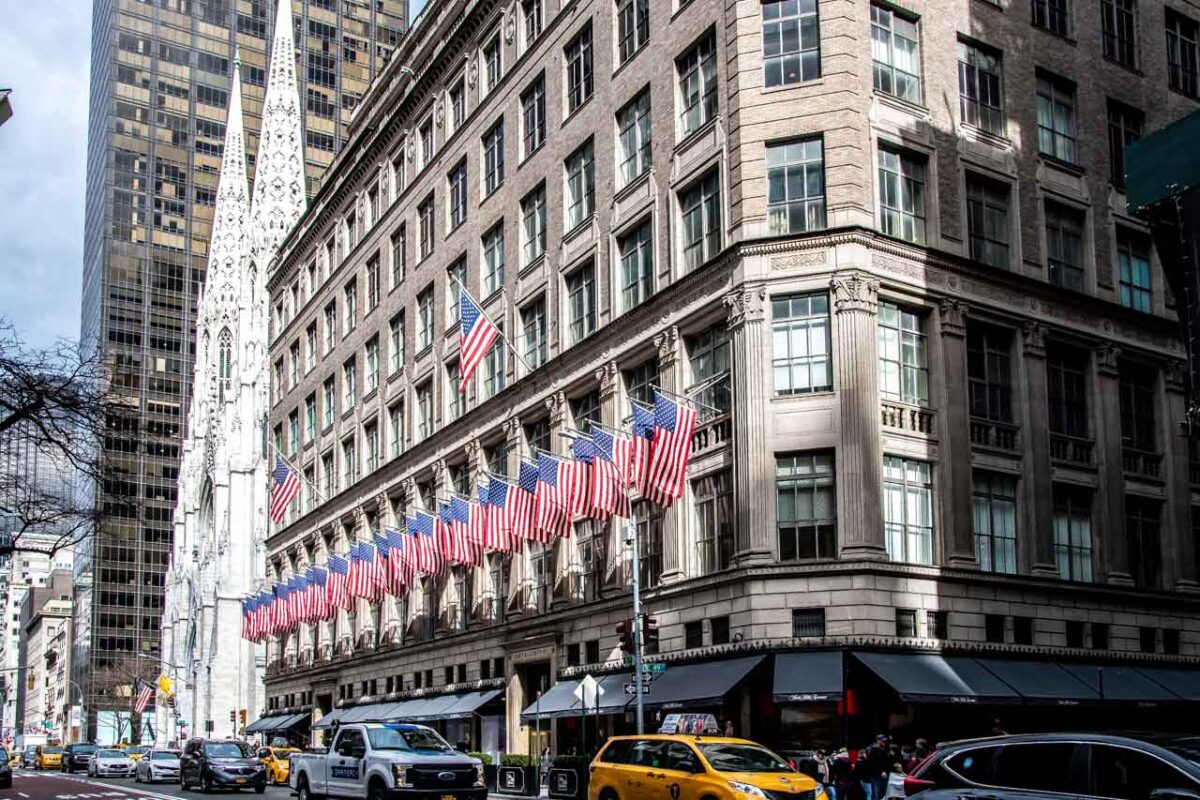
You are walking down Fifth Avenue. On the left, the Rockefeller Center blocks, on the right, the façade of Saks Fifth Avenue with a row of characteristic flags flapping in the wind. In between, a crowd of people with bags, the honking of yellow taxis, the smell of pretzels from a cart on the corner, and that New York energy that makes you automatically quicken your pace. Your brain processes stimuli faster than a laptop’s processor. And suddenly, somewhere between 50th and 51st Street, just behind the Saks flags, a white stone mass rises before you. Unnaturally calm. Unnaturally quiet. As if someone pasted it here from another era.
It is St. Patrick’s Cathedral, the largest neo-Gothic Catholic cathedral in North America. And one of those places in New York that can truly capture you. Not because you have to buy a ticket and stand in line. But because you step inside and suddenly hear silence. And in this place, silence is a luxury commodity.
In this guide, you will find everything you need to plan your visit: current opening hours, information about the new mural from 2025, practical tips, and some honest observations from my walks around Midtown.
Why is it worth visiting St. Patrick’s Cathedral?
Free admission, silence in the heart of Manhattan, and neo-Gothic architecture that contrasts with the surrounding glass skyscrapers. Those are the main reasons.
I won’t tell you that “you must be here”. But I’ll say this: if you spend even two days in New York, sooner or later you will find yourself on Fifth Avenue, somewhere near Rockefeller Center. And then you have two options. You can keep going, rushing to the next point on the list. Or you can step into the Cathedral for 15 minutes and do something that is almost impossible in this city: stop.
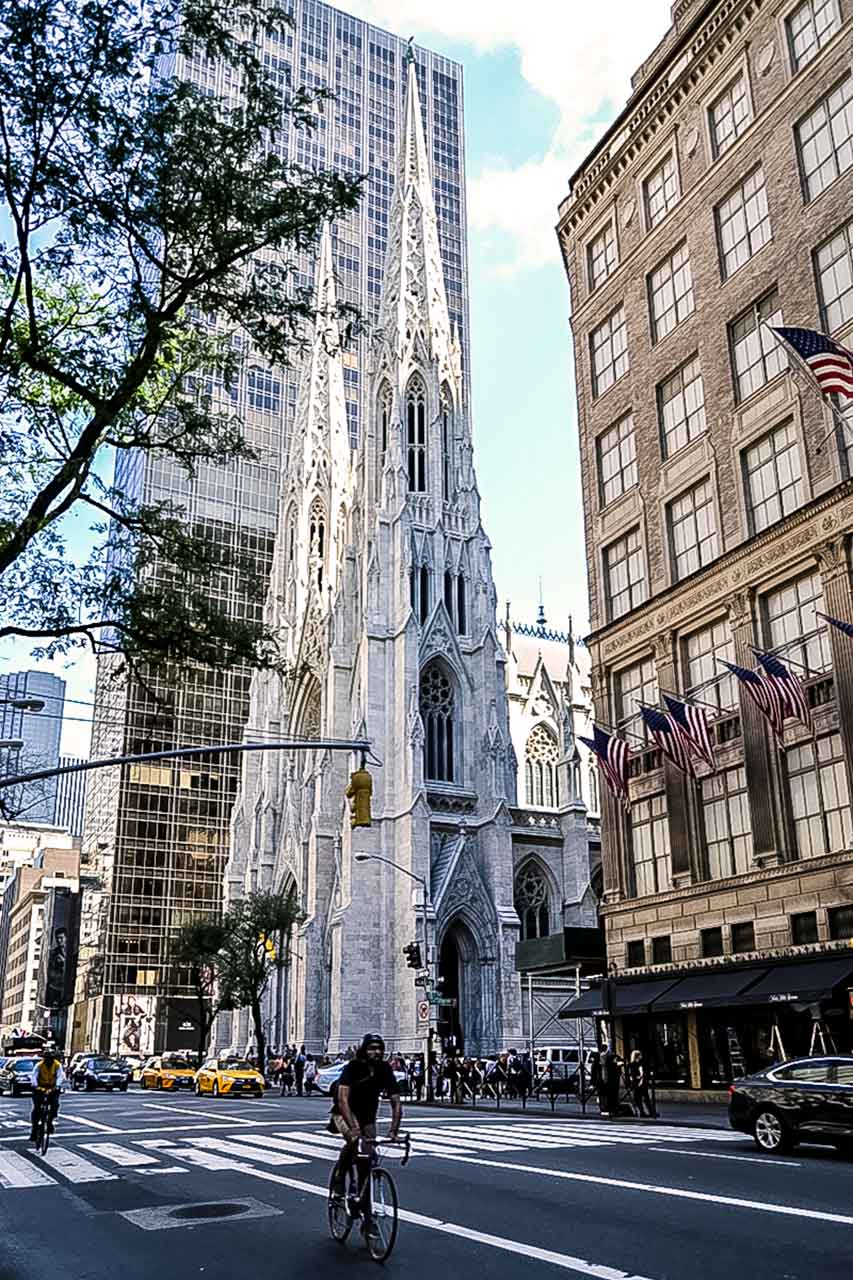
St. Patrick’s Cathedral is not just another “attraction to check off”. It’s a filter. You enter with the noise of Fifth Avenue in your ears, and you leave with a completely different rhythm. High ceilings, light filtered through stained glass, the scent of stone and wax. Even if you’re not a believer, this building affects the senses regardless of your beliefs.
And there’s also the contrast, which is noteworthy in itself. The Cathedral stands directly opposite the gigantic statue of Atlas at Rockefeller Center. On one side, a guy bearing the weight of the world on his shoulders (an ideal metaphor for us tourists, who plan every minute in Excel), and on the other, an interior suggesting that maybe it’s worth setting that world aside for a moment.
How was St. Patrick’s Cathedral in Manhattan built?
The construction began in 1858 at the initiative of Archbishop Hughes, and the consecration took place in 1879, the same year a miracle occurred in Knock.
To understand why this cathedral stands here at all, we need to go back to the mid-19th century. New York was bursting at the seams with Irish immigrants escaping the Great Famine. Archbishop John Hughes, himself of Irish descent, decided to build a cathedral that would not only be a sanctuary but also a symbol. A testament that the immigrant community is not just ‘temporary’.
In 1858, a cornerstone was laid at a spot that was then almost on the outskirts of Manhattan. Imagine: no skyscrapers, no Rockefeller Center, just vacant lots and muddy roads. People shook their heads because building a cathedral ‘at the end of the world’ seemed madness. History, however, showed that Hughes was right, for the city came to the cathedral, not the other way around.
The project was entrusted to James Renwick Jr, one of the most talented American architects of the time, who drew inspiration from European Gothic cathedrals, particularly the cathedral in Cologne and Amiens. Construction lasted over 20 years (interrupted by the Civil War), and the formal opening took place in 1879. Interestingly, in the same year, a Marian apparition occurred in the Irish town of Knock, the motif of which appears in the new mural of the cathedral.
The towers were completed only in 1888, and the last major renovation, costing 177 million dollars, took place from 2012 to 2015, restoring the facade to its original white appearance.
What distinguishes the architecture of St. Patrick’s Cathedral?
Neogothic style, white marble, and towers reaching over a hundred meters create an extraordinary contrast with the glass skyscrapers of Midtown.
This building impresses everyone, and it really doesn’t matter how much you know about architecture. The cathedral is constructed from white marble (quarried in Massachusetts and New York) that looks like something from a completely ‘different density of matter’ against the surrounding glass skyscrapers. It’s a clash of two worlds: the ultra-modern New York, which changes every season, and a structure that has a deep sense of what is currently in vogue.
The facade from Fifth Avenue is a sight to behold before you enter the interior. The soaring towers (each rising over one hundred meters above the street) topped with ornate pinnacles, three impressive entrance portals, and massive bronze doors weighing over 4 tons, which (incredibly) can be opened by a single person.
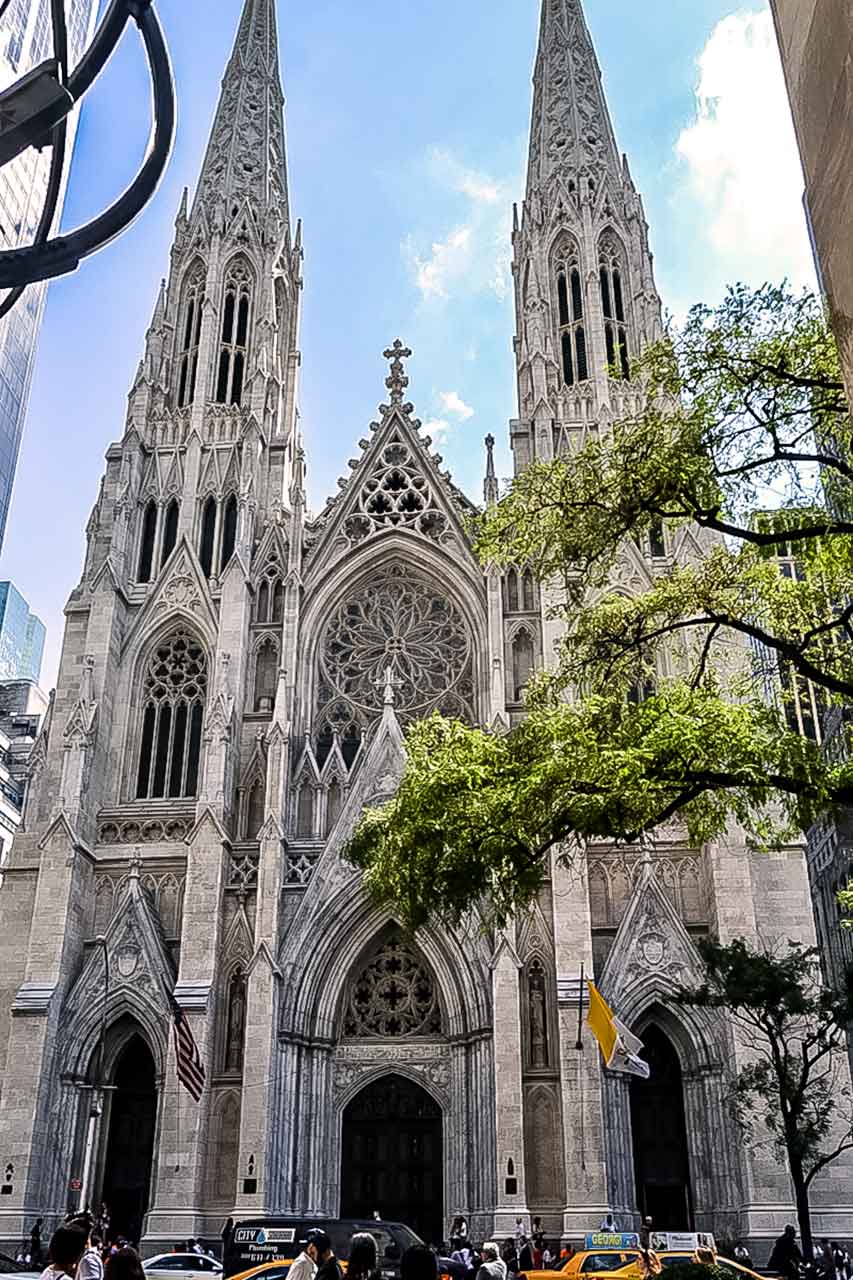
The style is Neo-Gothic inspired by English, French, and German Gothic architecture. Renwick did not copy any specific European cathedral but created his own synthesis, adapted to the scale and ambition of New York. The result? A building that occupies an entire city block (from 50th to 51st Street along Fifth Avenue) and can accommodate around 2400 people.
Stained glass and the interior of the Cathedral: what to see inside?
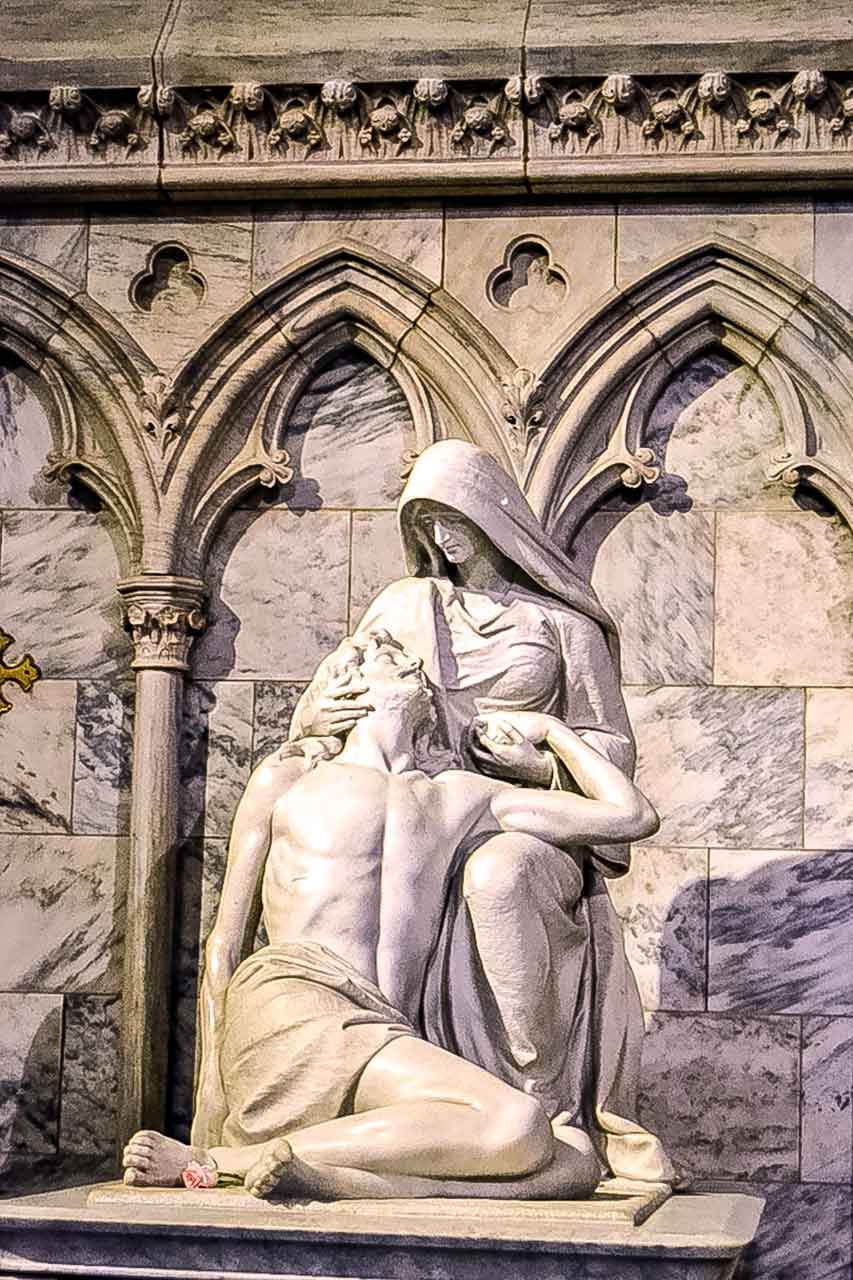
Over 70 stained glass windows (mainly from France and England), a powerful Pieta three times larger than that of Michelangelo and 21 side altars.
The most powerful moment? Just stepping inside. You cross the threshold and something strange happens. The noise of Fifth Avenue fades away, as if someone has cut off the power. It is not “silence” in the sense of lack of sound, but a silence that holds weight. The high vaults (the main nave is over 33 meters high) and the light streaming through the stained glass compel you to downshift. Really.
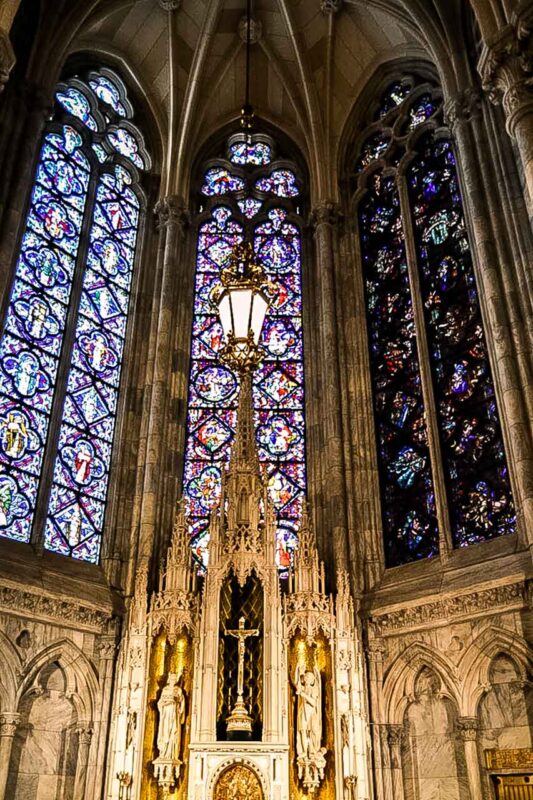
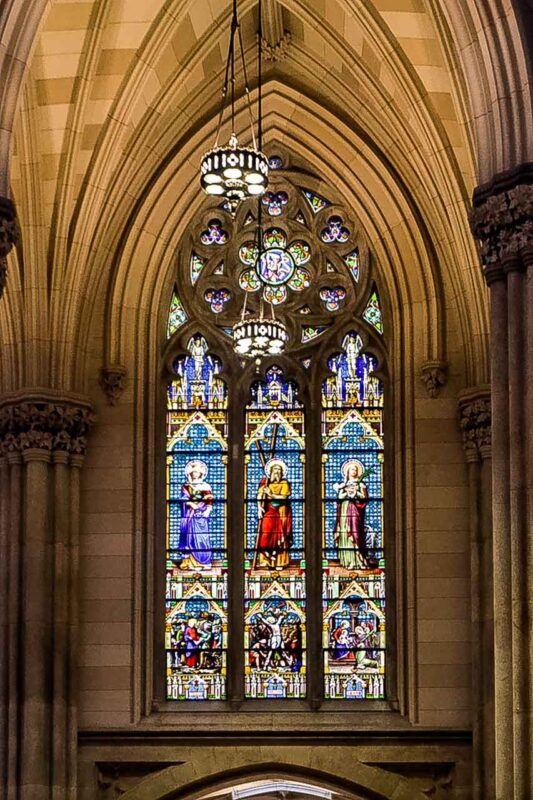
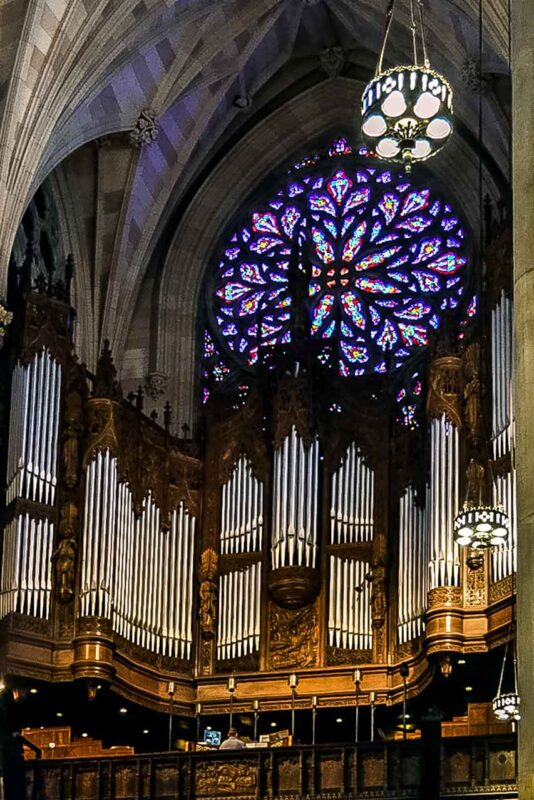
The stained glass itself is a separate story. There are over 70 of them in the cathedral, and the oldest date back to the 1870s and 1880s, primarily commissioned in Great Britain and France. More were added over the following decades, so it is actually a living chronicle of glass and light stretched over more than a hundred years. The largest rose window above the main entrance has a diameter of over 7.5 meters. When the sun hits at the right angle (best in the early afternoon), colorful patches of light cast themselves on the marble floor like a painting. The windows of Lady Chapel were designed by Paul Vincent Woodroffe and completed in 1930.
What else to pay attention to inside:
New mural in St. Patrick’s Cathedral: what you need to know?
In September 2025, a mural by Adam Cvijanovic, the largest commissioned work in the 146-year history of the cathedral, was unveiled.
If you visited the cathedral before 2025, the entrance on Fifth Avenue looked quite austere. Now it is completely different. In September 2025, a monumental mural by Brooklyn artist Adam Cvijanovic (pronounced tsi-ya-no-vich), titled What’s So Funny About Peace, Love, and Understanding, was unveiled. The title, borrowed from an Elvis Costello song, sounds surprising in the context of the cathedral, but the work itself is deeply serious and moving.
The mural occupies all three walls of the narthex facing Fifth Avenue. It consists of 12 panels, each about 7.5 meters high, and covers an area of over 178 m². It refers to the 1879 Revelation at Knock (the same year the cathedral was consecrated), depicting the figures of the Virgin Mary, St. Joseph, and St. John the Evangelist floating above scenes of immigration, both 19th-century Irish and contemporary newcomers from around the world.
All 75 figures in the mural are portraits of real people. Cvijanovic worked with live models (even the lamb is real, coming from a farm in New Jersey). You will also find historical figures in the painting: Archbishop Hughes, Mother Cabrini, Dorothy Day, and even St. Kateri Tekakwitha, the only Native American among Catholic saints. Two enormous angels beside the entrance doors hold symbols of service (a firefighter’s helmet, a police cap) and a miniature panorama of New York City.
Gold leaves (over 5200 sheets of 5-carat gold) give the whole a Byzantine glow, which dialogues with the organ pipes above. When the cathedral doors are open, you see directly at the sculpture of Atlas across the street, and the Art Deco Rockefeller Center blends with the sacred gold of the mural. This is a new, vibrant heart of the cathedral.
What are the opening hours of St. Patrick’s Cathedral?
The cathedral is open daily from 6:30 AM (or 6:45 AM) to 8:45 PM. Admission is free; the audio tour costs $25 per adult.
Several important notes. The cathedral is an active place of worship, with services held several times a day (on weekdays at 7:00 AM, 7:30 AM, 8:00 AM, 12:00 PM, 12:30 PM, 1:00 PM, and 5:30 PM; on Sundays from 7:00 AM to 5:30 PM).
During services, it is not allowed to walk, take photos, or talk. This is not a ‘closure’ of the cathedral, but a different pace is simply required. If you encounter a service, please sit and wait, or leave and return in 30–40 minutes.
Audiotour is narrated by Cardinal Timothy Dolan and is available in five languages: English, Spanish, Italian, French, and Portuguese. Unfortunately, Polish is not available. You can download it to your own phone from App Store or Google Play (app TourPatron) or rent a tablet on-site. A children’s version is available only in English.
How is the best way to explore St. Patrick’s Cathedral?
Enter from Fifth Avenue, go through security check, and then stroll at your own pace. Come in the morning to avoid crowds.
Visiting the cathedral is simple and stress-free. You enter through the main entrance from 5th Avenue (between 50th and 51st Street), go through a security check (similar to the airport but faster) and you’re inside. You don’t need to reserve anything, you don’t need a ticket (unless you want the audiotour). You just walk in.
Three options for visiting
|
Option |
Time |
Cost |
For whom |
|
Self-guided visit |
15 – 30 min |
Free |
Everyone. Walk in, look around, take a breath, walk out |
|
Official audiotour |
1 – 1.5 h |
25 USD (adult), 20 USD (child) |
Lovers of history and architecture |
|
VIP Behind the Scenes |
approx. 1 h |
from approx. 50 USD |
Access to the crypts, main altar, and closed areas |
The VIP tour is the only option with a live guide. Groups are small (max 12 people), and the guide takes you behind the scenes: to the archbishops’ crypts, to the main altar, to normally inaccessible places. Reviews on TripAdvisor are enthusiastic, so if you like to “peek where it’s not allowed,” this is a good option. Reservations can be made through the site museumpatron.org or platforms like GetYourGuide and Viator.
When is the best time to visit?
On Tuesdays, Wednesdays, and Thursdays, there are fewer people than on other days. Mondays can be surprisingly crowded (peak hours between 11:00 AM and 8:00 PM). Sundays are mass days, so touring is limited. My advice: come on Tuesday or Wednesday morning, between 9:00 AM and 10:30 AM. The cathedral is almost empty then, and you can peacefully admire the stained glass.
How to get to St. Patrick’s Cathedral?
The nearest subway stations: 47-50 Sts–Rockefeller Center (lines B, D, F, M) and 51st Street (line 6). A short walk for a few minutes.
|
Transport |
Station/Details |
Time to the cathedral |
|
Subway (lines B, D, F, M) |
47-50 Sts–Rockefeller Center |
2–3 min walk |
|
Metro (line 6) |
51st Street |
3–4 min walk |
|
Metro (lines E, M) |
5th Ave/53rd St |
3–5 min walk |
|
Buses |
Lines M1, M2, M3, M4 (along 5th Ave) |
Stop by the cathedral |
|
Hop-on Hop-off |
All major lines have a stop at 5th Ave/50th St |
Directly |
|
Walking from Times Square |
About 10 blocks east and north |
12–15 min |
Driving in Midtown? Honestly, I don’t recommend it. Parking is expensive ($40–$60 for a few hours in garages) and stressful. The subway is faster, cheaper, and hassle-free. A single subway ride costs $2.90 (as of 2026), and a weekly Unlimited MetroCard is $34.
What to see near St. Patrick’s Cathedral?
Rockefeller Center, Top of the Rock, MoMA, Central Park, and Saks Fifth Avenue are literally just a few minutes walk from the cathedral.
The cathedral is located in the heart of Midtown Manhattan, so the list of things to see within a 10-minute walk is absurdly long. Here’s my personal selection:
What rules apply when visiting St. Patrick’s Cathedral?
Appropriate attire, silence inside, no food or drink allowed (except water). Men should remove their hats. Photography is allowed.
St. Patrick’s Cathedral is an active place of worship, not a museum, so there are several rules worth knowing before entering:
The general rule is simple: behave as if you were a guest in someone else’s home. Don’t speak loudly, don’t take selfies with a selfie stick in the middle of the nave, and remember that for many people this is a place of prayer, not a stop on a tour. A little respect costs zero zlotys and makes the experience better for everyone.
Frequently asked questions about St. Patrick’s Cathedral
Is there an admission fee for St. Patrick’s Cathedral?
No. Entrance to the cathedral is completely free. Only the optional audio tour ($25 USD for adults, $20 USD for children) and the “Behind the Scenes” VIP tour (starting at approximately $50 USD) require payment. Donations are welcome but not required.
How much time do I need to visit St. Patrick’s Cathedral?
A self-guided visit usually takes 15–30 minutes. If you use the audio tour, plan for about 1–1.5 hours. The VIP tour lasts approximately one hour. If you are short on time, even 10 minutes inside provides that exceptional sense of peace that everyone talks about.
Can I enter the cathedral during Mass?
Yes, but you are not allowed to walk around, take photos, or talk during the service. You may sit in the pews and participate in the liturgy. If your goal is sightseeing, it is better to wait until the end of Mass (usually 30–40 minutes) or visit at another time.
Is St. Patrick’s Cathedral wheelchair accessible?
Yes. The cathedral provides access for wheelchair users, including ramps and dedicated entrances. For questions regarding specific amenities, you can contact the parish office at 14 E 51st Street.
In what languages is the audio guide available?
The audio tour is available in five languages: English, Spanish, Italian, French, and Portuguese. The children’s version is available in English only. If you do not speak any of these languages, a self-guided visit using a printed guide is equally rewarding.
What are the Mass times at St. Patrick’s Cathedral?
On weekdays, Masses are held at 7:00, 7:30, 8:00, 12:00, 12:30, 13:00, and 17:30. On Sundays: 7:00, 8:00, 9:00, 10:15, 12:00, 13:00, 16:00 (Spanish Mass), and 17:30. Always check the official website saintpatrickscathedral.org for the current schedule, as times may change during holidays.
Is St. Patrick’s Cathedral the largest church in New York?
In terms of importance and popularity, yes, but in terms of building size, the title belongs to the Cathedral of St. John the Divine on the Upper West Side, which is the largest Anglican cathedral in the world (and still unfinished!). St. Patrick’s Cathedral is, however, the largest Neo-Gothic Catholic cathedral in North America.
St. Patrick’s Cathedral is not just a church from a guidebook. It’s a filter through which you pass your New York day. You enter with noise, neon lights, and a checklist, and leave with the same checklist but with a lower pulse. 15 minutes inside does more for your head than an hour in a café.
If you are planning to explore New York and your route takes you through Midtown (which it probably does), don’t skip this place. Step inside, look around, admire the stained glass, and feel the contrast between the marble and the glass outside. And definitely check out the new mural, as it really changes the whole entrance experience.
And then step out onto Fifth Avenue and let Manhattan swallow you up again. But in a slightly different way.