Italiano
 Polski

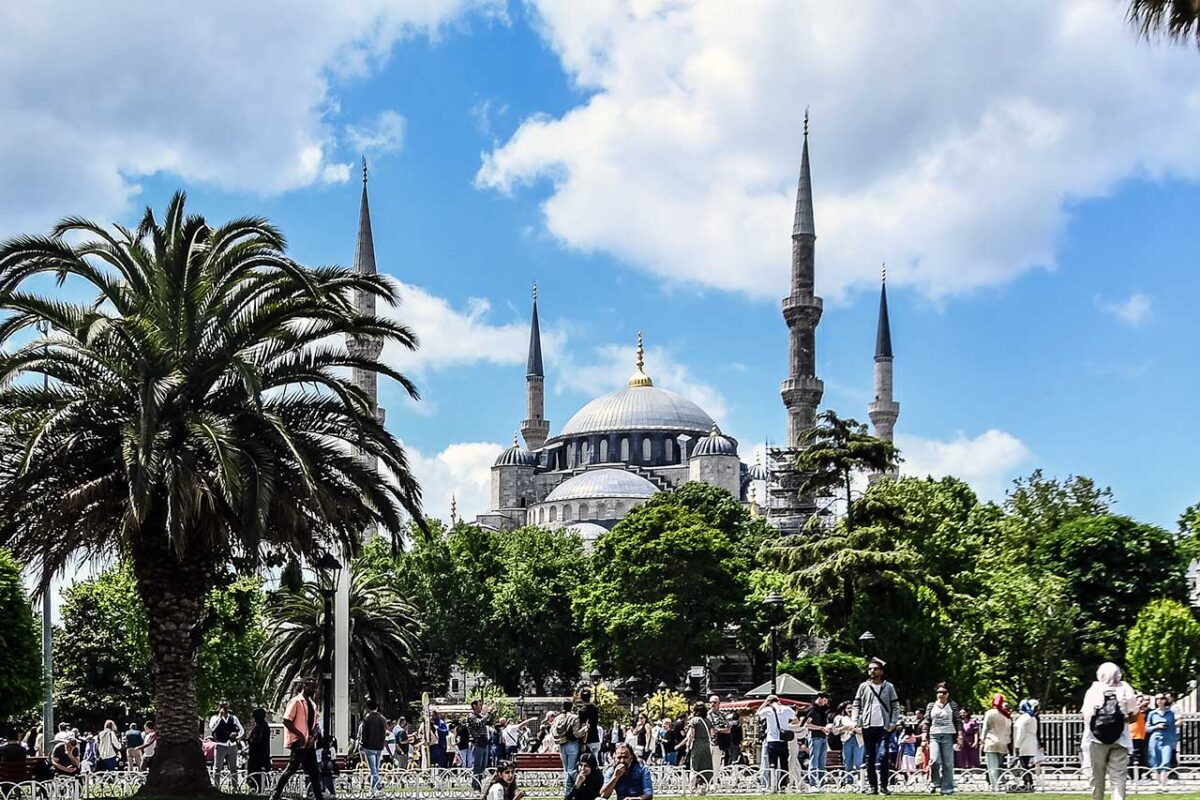
Did you know that the Blue Mosque in Istanbul is one of the few mosques in Turkey with six minarets? This exceptional sanctuary, visited by over 4.5 million tourists annually, once again captivates with its splendor after a thorough renovation in 2023. You certainly won’t miss it during your visit to Istanbul! This guide will tell you everything you need to know before visiting this architectural marvel.
The Blue Mosque in Istanbul, or Sultan Ahmed Mosque – why is it worth visiting?
The Blue Mosque in Istanbul, officially known as the Sultan Ahmed Mosque (Sultanahmet Camii) is one of the city’s major attractions, located in the Sultanahmet district, right next to Hagia Sophia. Built between 1609-1616 on the orders of Sultan Ahmed I, it was meant to be a testament to the Ottomans’ power. Why is it blue? It owes its popular name to over 20,000 blue ceramic tiles from Iznik, which adorn its interior with beautiful floral motifs.
Why is it worth it? The statistics speak for themselves: in 2024, 15 million tourists visited Istanbul, and the mosque is in the top 3 attractions. For you, it’s a chance for photos that will dazzle on Instagram, and surely a moment of reflection. If you love architecture, this place combines Byzantine influences with Ottoman ones – something you won’t find anywhere else. And after the 2023 renovation, the interior is fully accessible, without the restrictions of previous years.
Why is the Blue Mosque unique?
The mosque can accommodate 10,000 worshipers at once and still functions as an active place of worship.
The history of the Blue Mosque – from construction to renovation
Construction origins (1609-1616)
The history of the Blue Mosque begins in 1609 when the 19-year-old Sultan Ahmed I decided to build a mosque that would surpass all previous constructions in Istanbul. This decision was motivated not only by architectural ambitions but also political ones.
After the Peace of Zsitvatorok (1606), which was seen as a humiliation for the Ottoman Empire, the young sultan wanted to restore the state’s prestige and atone to Allah for his alleged youthful sins. Unlike his predecessors, Ahmed I funded the construction from the state treasury, not from war spoils, which caused controversy among Muslim clergy.
Designer and implementation
The architect of the mosque was Sedefkâr Mehmet Ağa, a student of the renowned architect Sinan. Construction lasted seven years and was completed in 1616. Tragically, Sultan Ahmed I died of typhoid just one year after the opening of his masterpiece, at the age of 27.
Symbolic location
The mosque was strategically placed opposite Hagia Sophia to rival this impressive Byzantine work, on the site of the former Byzantine hippodrome, symbolically taking over the place of former imperial power, and near the Topkapı Palace, emphasizing its imperial character.
Latest renovation (2018-2023)
In April 2023, the Blue Mosque was reopened after a comprehensive renovation, the most thorough in its 400-year history. The work began in 2018 and lasted six years, focusing on restoring the original splendor and enhancing earthquake safety.
Official Turkish sources, like Daily Sabah, report that more than 20,000 blue İznik tiles have been preserved – they were manually cleaned, removing dust and smoke without damaging the glaze. The main dome (with a diameter of over 23 meters) was restored by strengthening the structure, replacing lead coverings, and repairing cracks using scaffolding. The lighting was upgraded with LED installations, which better highlight the mosaics and the light from 260 windows, minimizing overheating. The foundations were reinforced with seismic elements, and drainage channels were cleaned to prevent flooding.
The architecture of the Blue Mosque – building details that amaze
Plan and sizes
The Blue Mosque was erected on a rectangular plan measuring 72 by 64 meters. The total area of the architectural complex is 4608 square meters. There are five gates leading to the mosque, and the entire ensemble is surrounded by a monumental courtyard.
Gates of the Blue Mosque
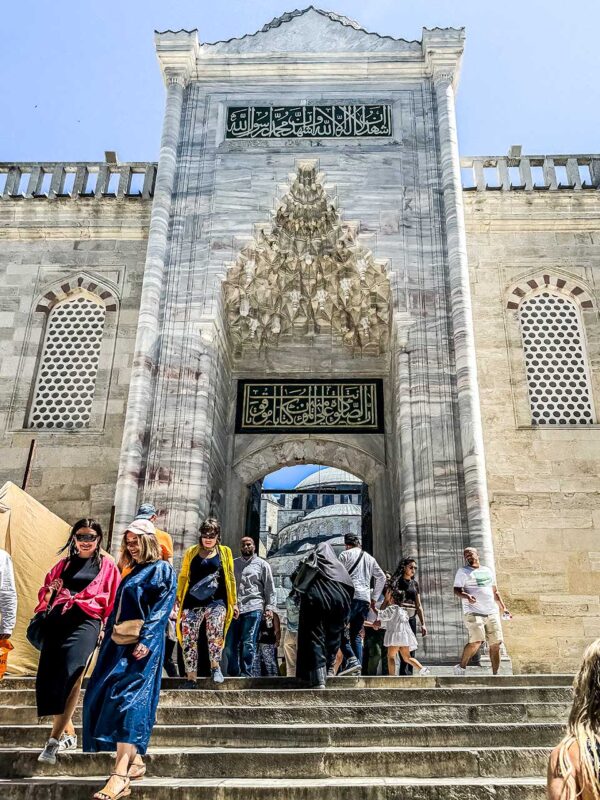
The Blue Mosque has six main gates that lead to the courtyard and the prayer hall itself. Three of them, external ones, are massive portals made of cedar wood and bronze, adorned with Quranic calligraphy and geometric patterns. The largest, the main gate, is 5 meters high and is flanked by marble columns. The other three gates, internal ones leading from the courtyard to the hall, are smaller but richly carved in marble with floral motifs.
After the renovation from 2018-2023, the gates shine – they were cleaned of rust, and the sculptures were renewed.
Fun fact: In the past, the sultan would ride through the main gate on horseback during ceremonies, and chains would block access to unauthorized persons.
Courtyard of the Blue Mosque
Courtyard of the Blue Mosque, known as avlu, is a monumental peristyle space, meaning it is surrounded by columns and arcades, serving as an integral part of the mosque. This is where the tour of the entire complex begins. The marble floor reflects the sun, and the arcades provide shade – perfect for photos, especially at sunset when minarets cast long shadows. In 2025, the courtyard is fully accessible after renovation, without scaffolding that previously spoiled the view.
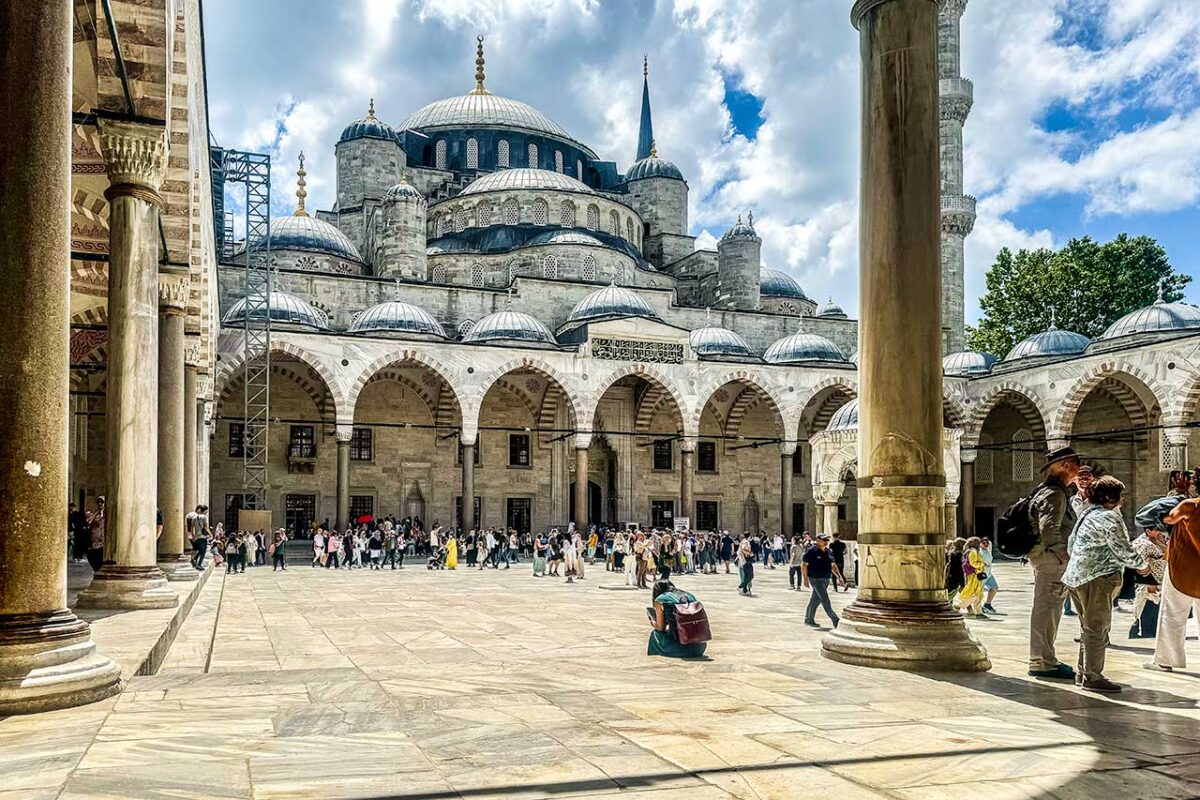
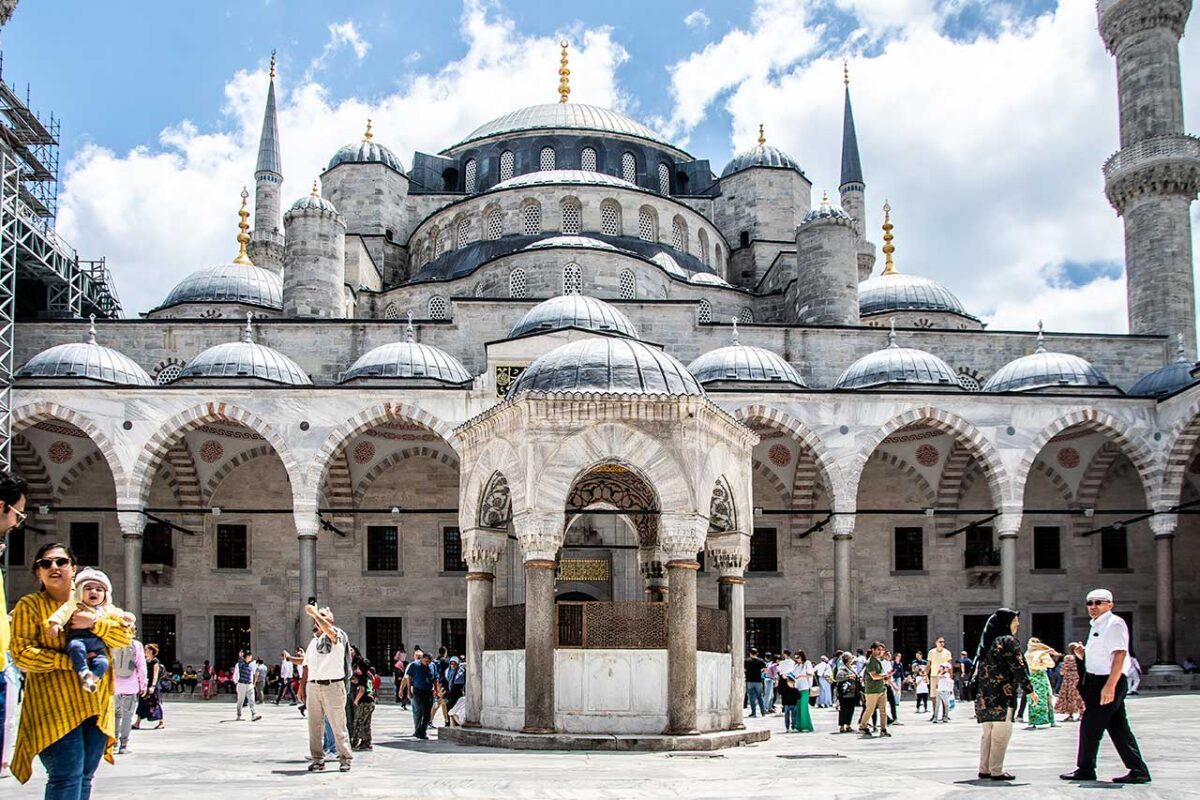
The courtyard is a single, unified plaza measuring approximately 70 by 80 meters, constructed of marble from the island of Marmara. At the center stands a hexagonal ablution fountain where the faithful prepare for prayer by washing their hands, feet, and face. According to Archnet.org, its peristyle structure – 26 granite columns supporting arcades – was inspired by Byzantine solutions but built with Ottoman grandeur.
Fun facts about the courtyard, gates, and columns
The fountain has six spouts, symbolizing minarets. The ‘elephant’ columns in the mosque weigh 100 tons each, and their foundations go 20 meters deep. Gates were closed with chains in the 17th century to protect against intruders. Birds nest in the arcades – local legend says they bring good luck. The courtyard can accommodate 5000 people during Ramadan.
Unique 6 minarets
The most distinctive feature of the mosque is the 6 minarets each 64 meters tall. According to legend, their number results from a linguistic misunderstanding – the sultan wanted ‘altın minare’ (golden minarets), but the architect understood ‘altı minare’ (six minarets).
This number of minarets caused controversy, as only the Al-Haram Mosque in Mecca had six minarets at the time. The problem was resolved by funding the construction of a seventh minaret in Mecca.
Prayer hall – the heart of the mosque
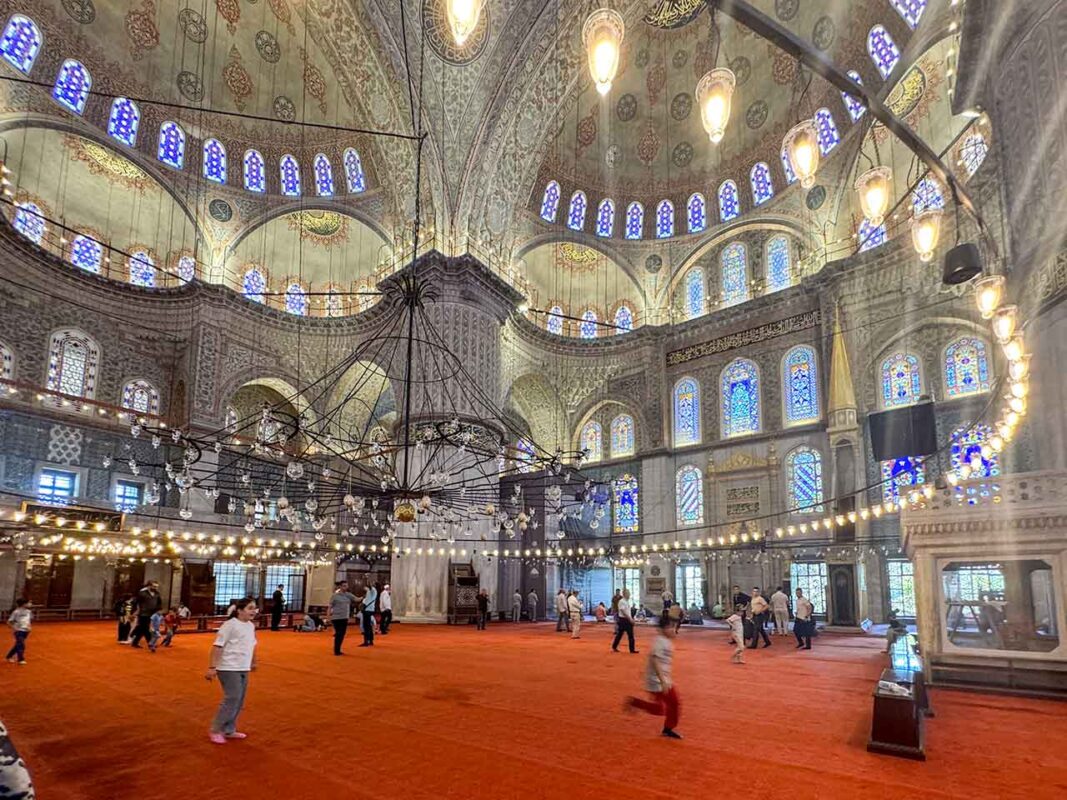
Upon crossing the threshold, you enter the prayer hall, measuring 53 by 51 meters and capable of accommodating 10,000 people. It is the central space of the Blue Mosque. Four marble columns, called ‘elephant legs’ (each with a diameter of 5 meters), support the main dome. The walls are covered with thousands of tiles, and light from 260 windows reflects off the marble. Daily prayers are held here, so maintain silence.
Iznik tiles in shades of blue
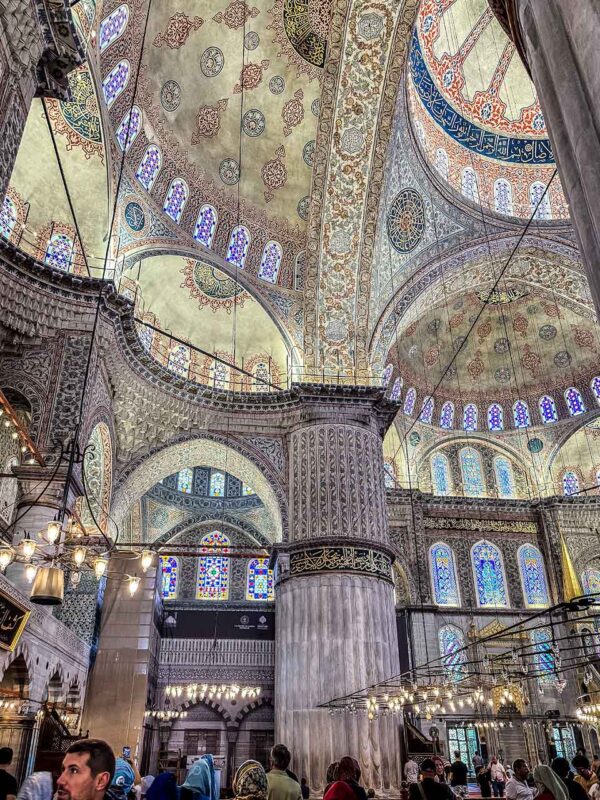
The interior of the mosque is adorned with 21,000 ceramic tiles from Iznik depicting over 50 different floral patterns: motifs of tulips, roses, carnations, and cypresses, verses from the Quran in beautiful Arabic calligraphy, and geometric patterns symbolizing infinity.
The tiles were made in the workshops of Iznik (ancient Nicaea), which during the construction of the mosque worked exclusively for its needs, significantly weakening other ceramic workshops in the empire.
Their blue color ranges from turquoise to navy, creating an illusion of the sky.
Key elements of the interior – mihrab, minbar, mahfil
In the hall, you will find several religious elements. The mihrab, a 3-meter-high marble niche indicating the direction of Mecca, is carved and surrounded by tiles – a landmark for worshipers. Next to it is the minbar, a pulpit made of cedar wood, from which the imam delivers sermons on Fridays; it is shaped like a tower with intricate carvings. Mahfil, an elevated platform for the sultan, is located on the right – adorned with gold and marble, used during ceremonies.
Dome and windows – play of light
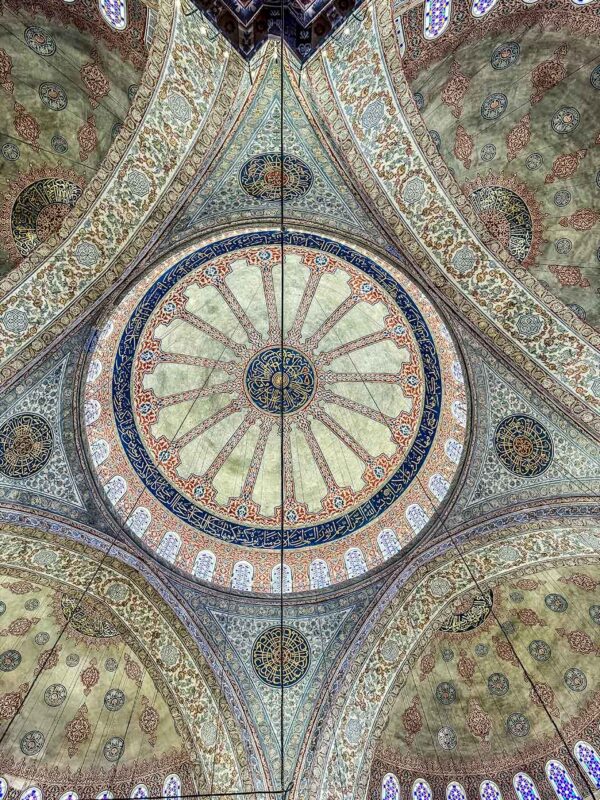
The main dome with a diameter of 23.5 meters rises 43 meters above the floor. Supported by four ‘elephant legs’ and smaller domes, it is covered with paintings and tiles. 260 windows, including 30 stained glass ones, allow light to enliven the blue.
Carpets and acoustics – practical details
The floor is covered with hand-woven carpets (approx. 5000 m²), replaced every few years, in shades of red and blue, providing comfort for worshipers. The acoustics of the hall are phenomenal – the echo lasts 8 seconds, enhancing the recitations of the Quran. After renovation, the carpets are new, and the acoustics improved thanks to cleaned walls.
Visiting the Blue Mosque in Istanbul – opening hours, tickets, and dress code
Opening hours in 2025
The Blue Mosque is open daily, but hours depend on prayer times.
Hours for tourists:
Prayer breaks (approx. 90 minutes each):
Tickets and costs
Entry to the Blue Mosque is free, as it remains an active place of worship. Voluntary donations for building maintenance are welcome.
Tour options:
Applicable dress code
Security check
You must go through a security check similar to the one at the airport. In the season, it can take 30-60 minutes, so plan additional time.
Interesting facts about Blue Mosque you didn’t know
Legends and anecdotes
Numbers that impress
Functions of the original complex
The Blue Mosque was part of a larger social complex (külliye), which included: a Madrasa (Quranic school), hospital, soup kitchen for the poor, shops and craft workshops, caravanserai for travelers, and the Mausoleum of Sultan Ahmed I.
Practical tips: How to avoid crowds and what to see in the area
Best times to visit the Blue Mosque
Morning hours (8:30-11:00):
Late afternoon (16:30-18:00):
Avoid:
How to get to the Blue Mosque
What to see nearby (within 500 meters)
Comparison: Blue Mosque to Hagia Sophia
These two monuments stand opposite each other and represent different eras of Istanbul. Here are the key differences:
|
Blue Mosque |
Hagia Sophia |
|
|
Year of construction |
1609-1616 |
537 AD (current form) |
|
Style |
Classical Ottoman architecture |
Byzantine architecture |
|
Function |
Active mosque |
Mosque (since 2020, previously museum) |
|
Admission |
Free |
Paid (200 Turkish lira) |
|
Minarets |
6 |
4 |
|
Characteristics |
Blue Iznik tiles, harmonious dome composition |
Giant dome, Byzantine mosaics, unique history |
FAQ – frequently asked questions about the Blue Mosque
Is the Blue Mosque open in 2025?
Yes, the mosque is fully open to tourists after the renovation was completed in April 2023. All parts of the temple are accessible.
Czy Błękitny Meczet jest otwarty w 2025 roku?
Tak, meczet jest w pełni otwarty dla turystów po zakończeniu renowacji w kwietniu 2023 roku. Dostępne są wszystkie części świątyni.
How much does it cost to enter the Blue Mosque?
Admission is free for all visitors. Voluntary donations for the maintenance of the monument are welcome.
Can you take photos inside the mosque?
Yes, you can take photos, but:
– without flash
– not during prayers
– no use of selfie sticks
Do I need a guide?
A guide is not mandatory, but highly recommended. They can help you:
– understand the history and symbolism
– avoid closing hours
– discover facts not found in guidebooks
– better plan sightseeing in the area
How much time do I need to visit?
Standard visit: 30–45 minutes
With a guide: 60–90 minutes
With queues: add 30–60 minutes in peak season
Can I wear shorts?
No, shorts are not allowed for men or women. Scarves and skirts are available at the entrance for free rental.
When are the shortest queues?
Shortest queues:
– early morning (8:30–10:00)
– late afternoon (after 16:30)
– weekdays (Tuesday–Thursday)
Avoid:
– Friday mornings
– weekends in peak season
– 12:00–15:00
Is the mosque accessible for people with disabilities?
Yes, the mosque has:
– ramps for wheelchairs
– elevators to the gallery (when open)
– accessible toilets
– designated parking spaces
Blue Mosque in Istanbul is not just any monument in Istanbul – it is an icon and testament to the power of the Ottoman Empire, as well as both a historical and religious site. After comprehensive renovation in 2023, it once again impresses with its blue color, inviting us to explore the mysteries of 400 years ago.
When planning a visit, remember to respect this sacred place and prepare for an unforgettable encounter with one of the most beautiful works of Islamic architecture in the world.
Sources: